NASA's Lucy is the first spacecraft to reach Jupiter's Trojans
Five years after launch, NASA's Lucy has entered the Jupiter Trojan asteroid region. Its first flyby, of Eurybates, is set for August 11, 2027. What comes next.
LandGadget Newsroom · · 3 min read
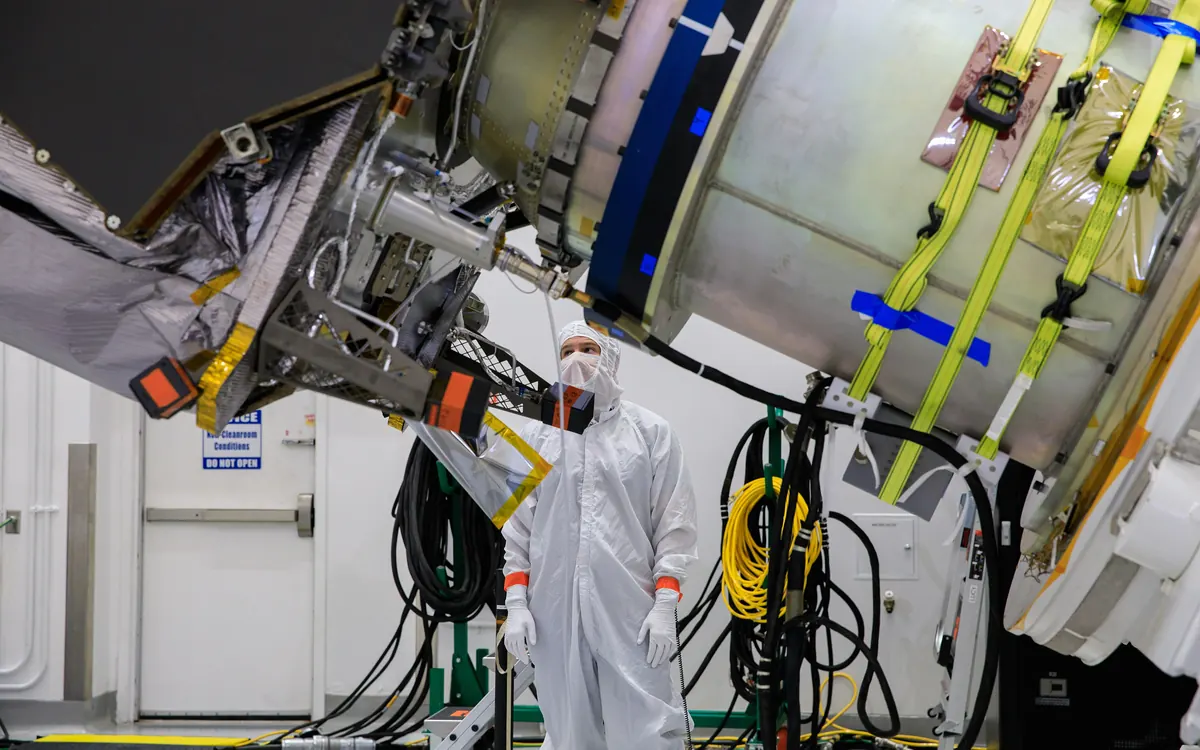
Five years and more than 2.2 billion miles after leaving Earth, NASA's Lucy probe has become the first spacecraft to enter the region of the Jupiter Trojan asteroids, NASA said on October 28. These are primitive bodies that share Jupiter's orbit around the Sun, and no mission has visited them before.
Where exactly is Lucy?
Space has no signposts, so mission engineers judge Lucy's position from its radio signals and from images of the background stars. According to NASA, the probe is now approaching Jupiter's Lagrange point 4 (L4) – one of two "islands of stability" where the gravity of the Sun and Jupiter combined holds thousands of asteroids in place. The L4 swarm travels ahead of Jupiter; a second swarm around L5 trails behind it. Both lie roughly as far from Jupiter as Jupiter is from the Sun, about 484 million miles.
Don't picture a crowded asteroid field from a film. NASA notes that Trojans are on average more than 6 million miles apart, so for now they look like moving pinpricks of light to Lucy's cameras.
Why no one has been here before
Several missions have flown past Jupiter, some using its gravity to sling themselves further out. None went to the Trojans, which sit far from the planet itself. Lucy was designed specifically for this population, and its systems are built for sunlight more than five times dimmer than at Earth. NASA says the spacecraft and its instruments continue to work as expected as it cools down in the outer solar system.
Scientists see the Trojans as leftovers from the era when the planets formed about 4.5 billion years ago. Close-up data should help test theories of how the giant planets ended up where they are today.
The flyby schedule
- August 11, 2027: Eurybates, the first Trojan encounter
- September 2027: Polymele
- April 2028: Leucus
- November 2028: Orus
- 2030: a third and final Earth gravity assist, sending Lucy to the trailing L5 swarm
- March 2033: the binary pair Patroclus and Menoetius
The team is now finalising plans for Eurybates, where Lucy will have only a few hours of close observation. Asteroid science is having a busy autumn: ESA's Hera probe has just resolved Didymos and Dimorphos as two separate objects on its way to the DART impact site. If the news makes you want to look up yourself, our beginner telescope guide explains what you can see from your back garden.
More from Science & Space
View all →Read next
Robot vacuums for carpets vs hard floors: what to look for
Carpet, rugs or hard floors? Which robot vacuum features matter for each: brushes, carpet boost, threshold height, mop lifting, edge cleaning and setup per room.

DLSS vs FSR vs XeSS: which upscaler should you use?
DLSS vs FSR vs XeSS explained: how each upscaler works, which GPUs support it, frame generation and lag, and which setting to pick on Nvidia, AMD or Intel.
Is fast charging bad for your phone battery?
Does fast charging damage your phone battery? How fast charging works, why heat matters more than watts, and simple settings that keep your battery healthy longer.