ESA's Hera sees Didymos and Dimorphos apart for the first time
ESA's Hera probe has resolved the Didymos–Dimorphos pair from 1,280 km away. First detailed Dimorphos images since DART's 2022 impact are due 25 November.
LandGadget Newsroom · · 3 min read
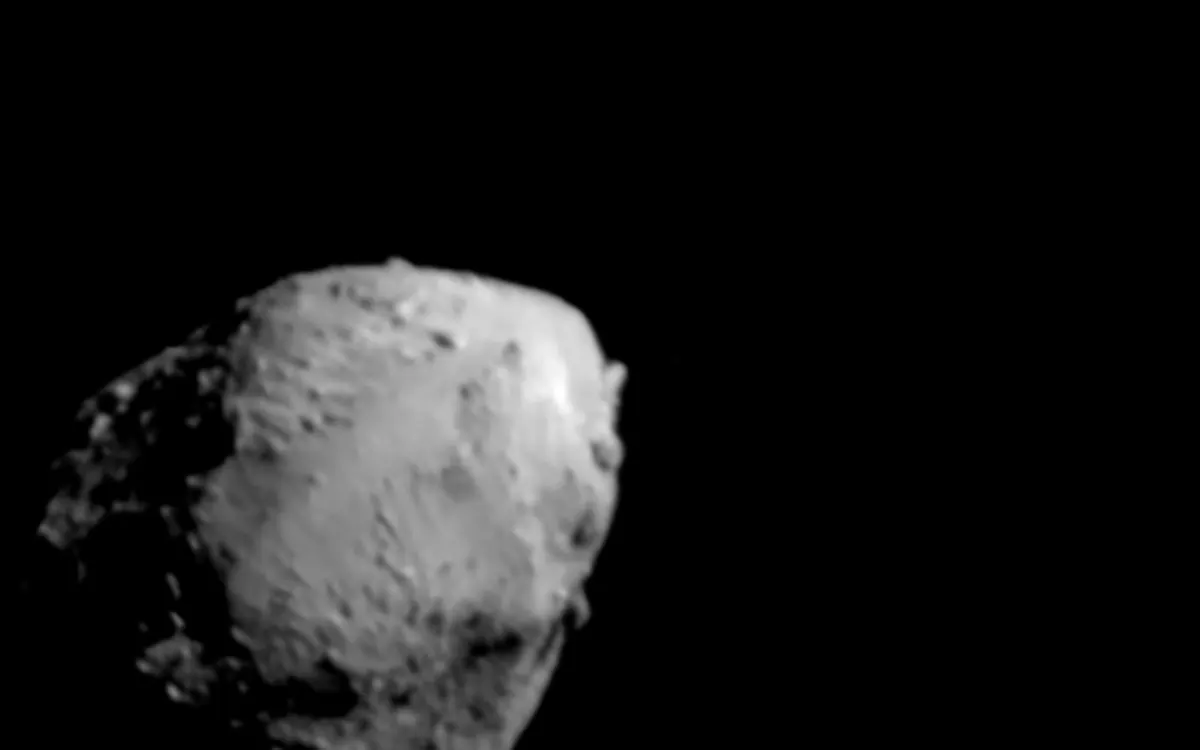
Europe's planetary defence mission has reached a milestone you can measure in pixels. ESA's Hera spacecraft has, for the first time, imaged the asteroid Didymos and its small moon Dimorphos as two separate objects, ESA announced on 27 October.
What Hera actually saw
The picture was taken on the evening of 18 October by Hera's monochromatic Asteroid Framing Camera, at a distance of about 1,280 km from the pair. The system itself is currently some 197 million km from Earth.
Until this shot, the two bodies blurred into a single dot. Now Dimorphos shows up as roughly one pixel, but ESA's Michael Kueppers says it is clearly separated from its parent. The image follows two braking burns, fired a week apart earlier this month, that slowed Hera to about 20 m/s relative to the asteroids so it can creep closer in controlled steps.
Why these two rocks matter
- Didymos is about 780 m across; Dimorphos is about 151 m, roughly the size of the Great Pyramid of Giza.
- The pair orbit an average 1.15 km apart, with Dimorphos moving at about 18 cm/s.
- On 26 September 2022, NASA's DART spacecraft deliberately hit Dimorphos at 6.1 km/s, shortening its orbit by around 33 minutes — the first time humans measurably shifted the path of a Solar System object.
DART proved a "kinetic impactor" can nudge an asteroid. What it could not show is what the hit did to Dimorphos itself: whether it left a crater or reshaped the whole body, and what its mass and structure are. Those answers decide how reliably the technique could be used against a real threat.
What comes next
Mission manager Ian Carnelli says the views will sharpen quickly. ESA plans to publish the first detailed images of Dimorphos on 25 November. Over the following months Hera will run a close-up "crash site investigation", release two shoebox-sized CubeSats for an even closer look, and eventually attempt a landing.
For more deep-space science, see our explainer on what a dark galaxy is and our report on the Spider crater impact structure in Australia. If you want to spot asteroids and planets yourself, start with our beginner telescope guide.
Frequently asked questions
Is Didymos a danger to Earth?
No. ESA and NASA chose the Didymos system because it poses no threat. It is a safe target for testing how an impact can change an asteroid's orbit.
When will Hera's detailed Dimorphos images be released?
ESA says it will unveil the first detailed images of Dimorphos on 25 November 2026.
More from Science & Space
View all →Read next
Robot Vacuum vs Stick Vacuum: Which Should You Buy?
Robot or cordless stick vacuum? Compare carpets, pets, stairs, effort, running costs and noise to pick the right one, or know when you need both.
Half-Life: Alyx adds foveated rendering on PC: which GPUs work
Valve's new Half-Life: Alyx patch adds a foveated rendering option on PC. It needs Nvidia GTX 16 or RTX 20 series or newer, AMD via Vulkan, and works best with eye tracking.
Samsung Community goes offline for 72 hours: back up first
Samsung Community shuts for 72 hours from October 30 for an overhaul. DMs, drafts, bookmarks and subscriptions won't migrate. What to save and what changes after.