Record gamma-ray burst kept flaring for 27 days
Astronomers say GRB 220706A's central engine stayed active for about 27 days, flaring in X-rays far later than any burst before. What may power it and why it matters.
LandGadget Newsroom · · 3 min read
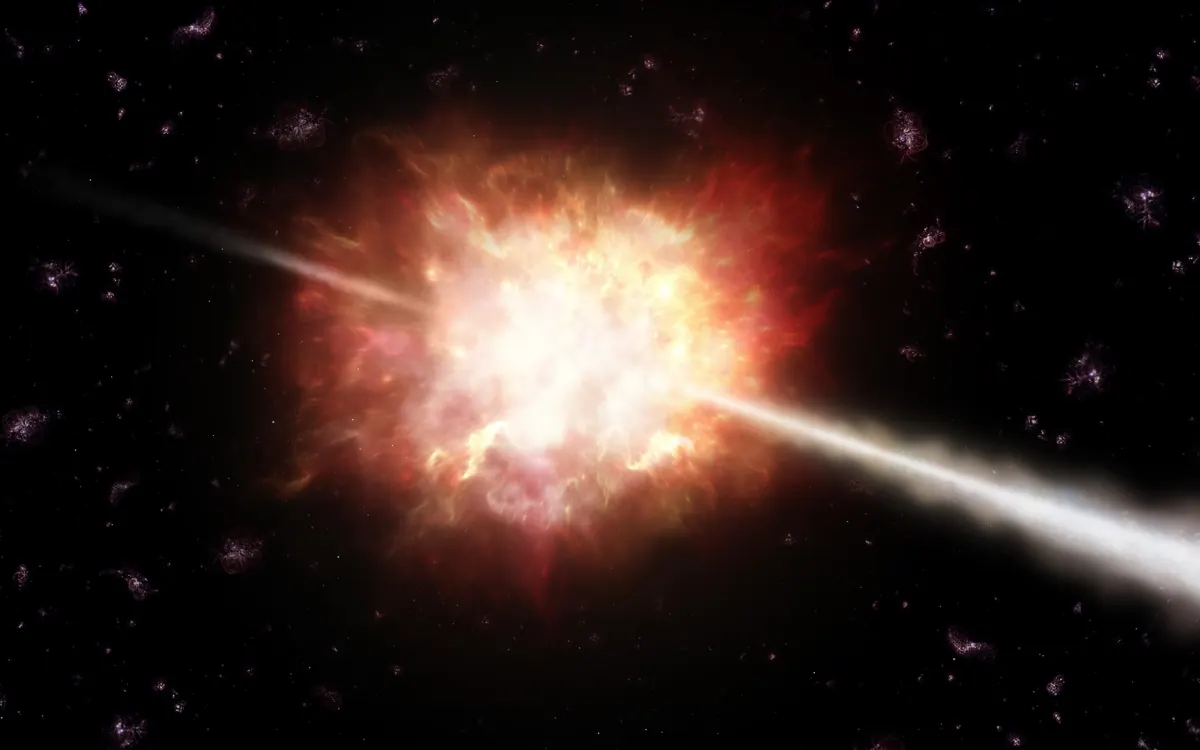
Gamma-ray bursts (GRBs) are among the most powerful explosions in the universe, and most are over in seconds or minutes. One spotted in 2022 refused to go quiet. A team of astronomers says the engine behind GRB 220706A kept working for roughly 27 days, producing X-ray flares long after the initial blast, Space.com reports.
What makes this burst different
X-ray flares after a GRB are common, but they normally arrive within the first few days. "The fact that we see flaring at around 27 days in the GRB's rest frame tells us that there's an ongoing active process, and that's unprecedented in the known population," study team member Benjamin Gompertz of the University of Birmingham told Space.com. He put the previous record for delayed flaring at about six days.
GRB 220706A belongs to a rare class called ultra-long GRBs, where the central engine stays active far longer than usual. Their cause is still unknown.
What could power it
The team also saw a supernova linked to the burst, which confirms that a massive star collapsed. That is the standard origin of long GRBs, but it does not explain flaring a month later or why the supernova was unusually bright. The researchers discuss a few options:
- A magnetar. An earlier ultra-long burst from 2011, GRB 111209A, also came with an unusually bright supernova and was interpreted as being powered by a magnetar, a neutron star with an extremely strong magnetic field. Gompertz says the new supernova "looks a lot like that one".
- Collisions with ejected shells. The jet and supernova might be slamming into dense material the star threw off near the end of its life.
- A bigger star. A larger star would take longer to collapse and could feed the jet for longer. Gompertz estimates the event needs a star around 1,000 times the radius of the Sun, closer to a blue supergiant than the Wolf-Rayet stars usually linked to GRBs.
Why we may be missing more of them
Bursts this long are hard to follow. Most detecting satellites are in low Earth orbit, so Earth blocks the target roughly every 90 minutes, and long events tend to be brighter in X-rays than in gamma rays. Gompertz suggests X-ray-focused missions such as the Einstein Probe could find more.
The work has been posted to arXiv and has not yet been peer reviewed, so the conclusions may still change.
For context, NASA's Swift observatory, one of the main GRB hunters for two decades, recently ended its mission, as we reported in NASA's Swift mission ends. And if you like open questions in astrophysics, our explainer on what dark matter is covers another big one.
More from Science & Space
View all →Read next

Samsung reportedly cuts Galaxy A output 20% on memory costs
ETNews says Samsung is cutting Galaxy A production by about 20%, roughly 10 million phones, to favour flagships as memory and chip costs squeeze margins.

How to choose a tablet in 2026: iPad, Android or Windows?
Tablet buying guide 2026: iPad vs Android vs Windows, screen size, OLED vs LCD, RAM and storage, stylus and keyboard costs, cellular and software updates.

Lidar vs cameras for self-driving cars: which is better?
Lidar vs cameras vs radar: how each self-driving sensor works, why Tesla uses cameras only while Waymo, Mercedes and the Rivian R2 add lidar, and what it means.