Iceberg A-81 reaches South Georgia after a 3-year drift
NASA satellite images show Antarctic iceberg A-81, about 1,550 km² of ice from the Brunt Ice Shelf, slowing at South Georgia's undersea shelf. Its route and why it matters.
LandGadget Newsroom · · 3 min read
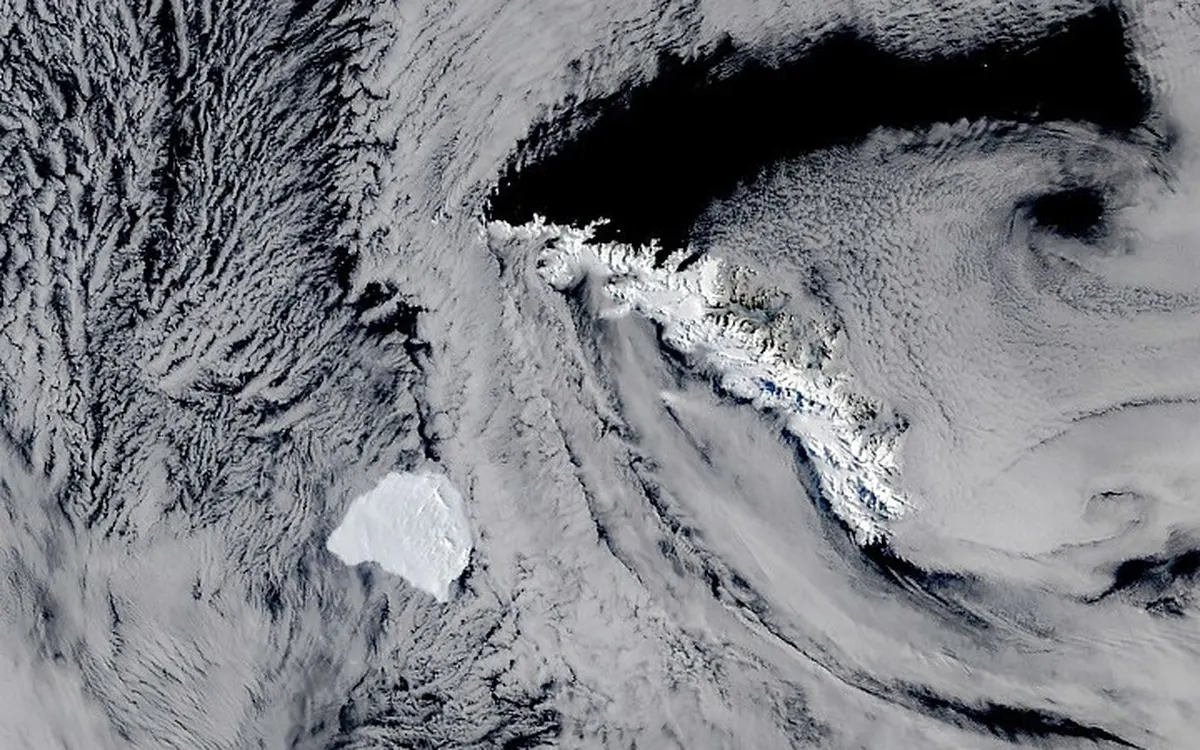
One of Antarctica's big icebergs has reached the end of a long road. Iceberg A-81 is now off South Georgia, a remote island in the South Atlantic, and it has slowed down noticeably as it scrapes along the island's underwater shelf, NASA Earth Observatory reports. The cover image above was taken by the MODIS instrument on NASA's Terra satellite on 20 October.
How big is A-81?
A-81 covers roughly 1,550 square kilometres (600 square miles). It broke away from the Brunt Ice Shelf in January 2023, along a rift called Chasm 1. That crack had been stable for about 35 years before it started growing again around 2012; by 2019 a break looked imminent, but the ice held on for several more years.
The route it took
Some icebergs stay near Antarctica for decades, grounding near their home shelf or circling the continent on coastal currents. A-81 took the faster exit:
- It spent more than three years in the Weddell Sea, carried along the coast by the clockwise Weddell Gyre.
- By May 2026 it reached the tip of the Antarctic Peninsula.
- It then moved north into the Scotia Sea.
- By late October 2026 it approached South Georgia, about 2,300 km (1,400 miles) north-northwest of the Brunt Ice Shelf.
Why it slowed at South Georgia
The island sits on a shallow underwater shelf, and big, deep icebergs can catch on it. According to Jan Lieser of Australia's Bureau of Meteorology and Christopher Shuman (University of Maryland, retired), A-81 appeared to be bumping along the edge of that shelf in the days before the image was taken. It has happened before: in 2025, iceberg A-23A ran aground on the same shelf and later broke apart.
Why scientists watch Brunt
Calving is a normal part of an ice shelf's life, but the Brunt Ice Shelf has shed several large icebergs in quick succession. It is also home to the British Antarctic Survey's Halley Research Station, a major base for Earth, atmospheric and space science since the 1950s. Besides A-81, Brunt produced A-74 in 2021 (it has since broken up) and A-83 from the "Halloween Crack" in 2024. A-83 is still intact and trailing A-81 north, along with a handful of other bergs leaving the Weddell Sea.
Satellites like Terra are how researchers follow these icebergs across thousands of kilometres of open ocean. For more Earth-from-orbit stories, see how NASA's PACE satellite tracks autumn colours and the NASA images of Australia's Spider crater.
Frequently asked questions
Where is iceberg A-81 now?
As of late October 2026 it is off South Georgia, a remote island in the South Atlantic, where it slowed while bumping along the island's undersea shelf.
How big is iceberg A-81?
About 1,550 square kilometres, or 600 square miles, according to NASA Earth Observatory.
Where did A-81 come from?
It calved from Antarctica's Brunt Ice Shelf in January 2023, along a rift known as Chasm 1.
What happened to iceberg A-23A?
In 2025 A-23A ran aground on the same South Georgia shelf and later broke apart.
More from Science & Space
View all →Read next

Samsung Community goes offline for 72 hours: back up first
Samsung Community shuts for 72 hours from October 30 for an overhaul. DMs, drafts, bookmarks and subscriptions won't migrate. What to save and what changes after.

How much VRAM do you need to run AI models locally?
How much VRAM you need for local LLMs: a simple formula for model weights, quantisation and KV cache, worked examples, and which GPU memory tier fits which model.

Hybrid vs plug-in hybrid vs EV: which should you buy?
Hybrid, plug-in hybrid or electric car? How each works, real-world fuel use, charging needs and costs, and a simple way to pick the right one for how you drive.