Perseverance finds ultrafine Mars dust on spacesuit fabric
NASA's Perseverance rover measured fine and ultrafine Martian dust on spacesuit samples it carries, data that could shape suits, habitats and crew health rules.
LandGadget Newsroom · · 3 min read
On this page
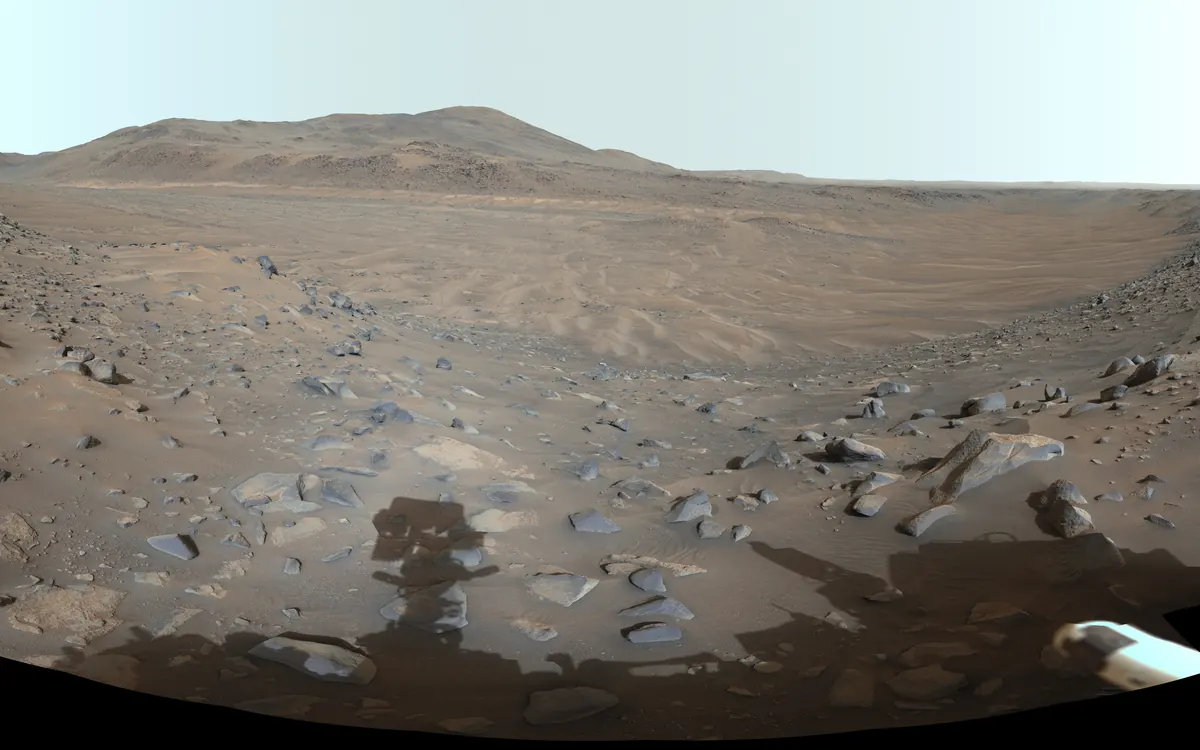
NASA's Perseverance rover was sent to Mars to look for signs of ancient life, but it also carries small pieces of spacesuit material. After 1,645 Martian days on the surface, those swatches have produced the first direct measurements of the planet's finest dust. The study is published on 27 October 2026 in the Proceedings of the National Academy of Sciences (PNAS), NASA's Jet Propulsion Laboratory says.
How a calibration target became a dust detector
The rover's SHERLOC instrument uses a calibration target that includes five spacesuit samples, each about 20 mm square, among them Teflon and Vectran. The PIXL X-ray instrument has its own target with a piece of Teflon and basaltic glass.
Teflon contains no elements PIXL can detect directly. So any chemical signal PIXL picks up from that sample must come from dust sitting on it, a neat way to reuse hardware that was never designed as a dust sensor.
Finer than ever measured on Mars
Earlier missions could resolve Martian dust down to about 3 micrometres. PIXL found two smaller classes:
- fine particles under 2.5 micrometres (a human hair is about 70 micrometres wide);
- ultrafine particles of around 100 nanometres.
On PIXL's Teflon and SHERLOC's Vectran swatch, particles averaged about 2 micrometres. On the basaltic glass and SHERLOC's Teflon sample, sizes went down to roughly 100–300 nanometres.
Static electricity appears to decide what sticks where. Grains become charged as they collide in the air, and different materials attract different sizes. "The larger clumps, the Martian dust bunnies, get shaken off over time. But the smallest particles stay behind," lead author Scott VanBommel of Washington University in St. Louis said.
The dust matched the iron- and sulfur-rich chemistry seen before, and PIXL also found it enriched in phosphorus, with signs of calcium sulfate.
Why it matters for astronauts
On Earth, particles below 2.5 micrometres can reach deep into the lungs and enter the bloodstream. NASA notes that Martian dust also carries perchlorates, which can disrupt thyroid function, and reactive iron that can damage cells. Apollo crews already learned that lunar dust scratches visors, wears down suit layers and damages seals.
Because some materials collected less dust than others, the data can help choose fabrics and coatings for suits and habitats. NASA also mentions suitports and dual-chamber airlocks as ways to keep dust out of living quarters, alongside dust-clearing tech it has tested on the Moon.
For more on the rover's journey, see our report on Perseverance's driving distance record. If you'd like to look at Mars yourself, our beginner telescope guide explains what you can expect to see.
More from Science & Space
View all →Read next
How much VRAM do you need to run AI models locally?
How much VRAM you need for local LLMs: a simple formula for model weights, quantisation and KV cache, worked examples, and which GPU memory tier fits which model.

Samsung reportedly cuts Galaxy A output 20% on memory costs
ETNews says Samsung is cutting Galaxy A production by about 20%, roughly 10 million phones, to favour flagships as memory and chip costs squeeze margins.

Lidar vs cameras for self-driving cars: which is better?
Lidar vs cameras vs radar: how each self-driving sensor works, why Tesla uses cameras only while Waymo, Mercedes and the Rivian R2 add lidar, and what it means.