What is a dark galaxy? Starless galaxies explained
A dark galaxy is a clump of dark matter and gas with few or no stars. How astronomers find them, the best candidates like Cloud-9, and why they matter.
LandGadget Newsroom · · 7 min read
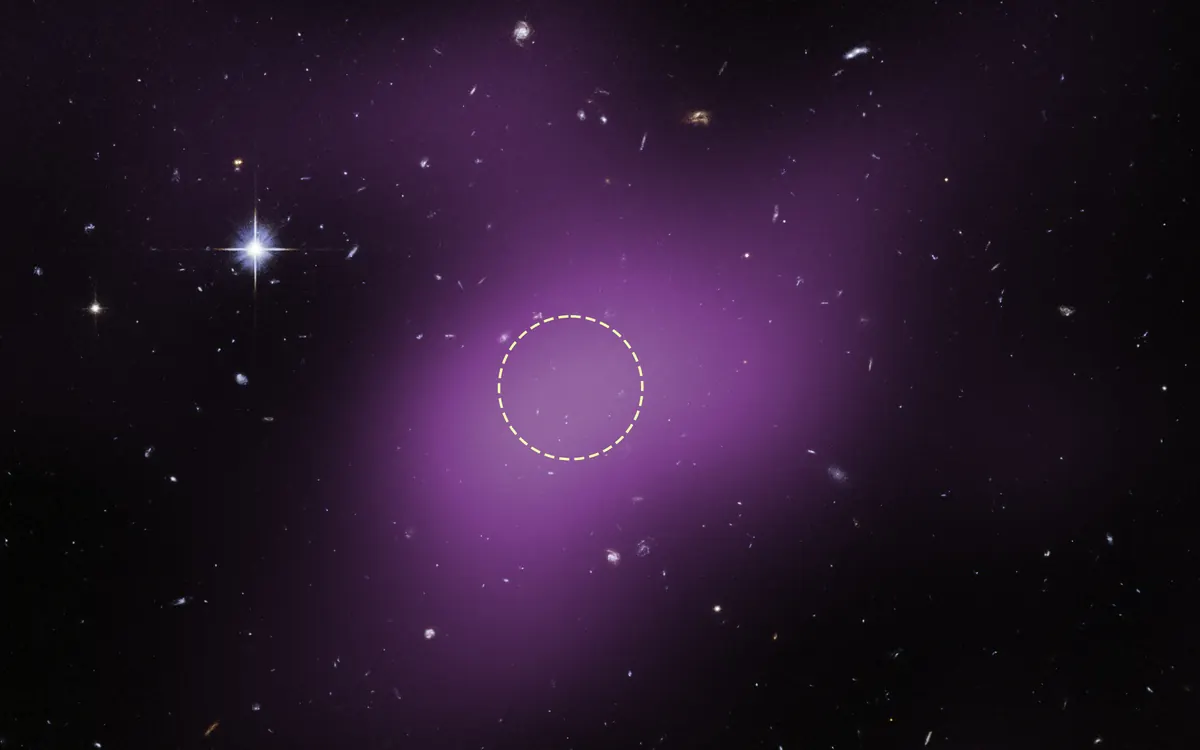
Most galaxies announce themselves with light: billions of stars, glowing gas, spiral arms. A dark galaxy is the opposite. It is a galaxy-sized clump of matter that holds gas, and is mostly dark matter, but has formed few or no stars. Without starlight it is nearly invisible in an ordinary telescope, which is exactly why astronomers have argued about these objects for decades.
This guide explains what dark galaxies are, why theory predicts them, how they are found and which candidates are taken most seriously today.
The short definition
Think of a normal galaxy as a city lit up at night. Underneath the lights is a much larger, invisible foundation: a halo of dark matter that holds everything together with its gravity. In a galaxy like the Milky Way, dark matter outweighs ordinary matter by roughly five to one. (Our dark matter explainer covers why scientists are confident it exists even though nobody has seen it directly.)
A dark galaxy is that foundation with the lights mostly switched off. It still has a dark matter halo and often a cloud of neutral hydrogen gas, but the gas never collapsed into stars, or only a tiny number formed. Astronomers use several labels that overlap:
- Dark galaxy: the general term for a starless or nearly starless galaxy.
- RELHIC: short for "reionization-limited H I cloud", a small dark matter halo holding hydrogen that was too warm and too thinly spread to make stars.
- Dark-matter-dominated galaxy: a galaxy that does have some stars, but where dark matter makes up almost all of its mass.
Why theory predicts them
The standard model of cosmology, called Lambda-CDM, predicts that the universe should contain huge numbers of small dark matter halos, far more than the dwarf galaxies we actually see around the Milky Way. That mismatch is sometimes called the "missing satellites" problem.
One explanation is that many small halos simply failed to form stars. In the early universe, the first stars and galaxies flooded space with ultraviolet light, an era called reionization. That radiation heated gas. In big halos gravity was strong enough to pull the warm gas together anyway, and stars formed. In small halos it was not: the gas stayed puffy and diffuse, sitting in the halo like a cloud that never rains. Those are the objects astronomers now call RELHICs, and finding them is a direct test of how dark matter behaves on small scales.
How do you find something dark?
If a dark galaxy emits almost no starlight, astronomers have to catch it some other way. There are three main methods.
1. Listen for hydrogen
Neutral hydrogen gives off radio waves at a wavelength of 21 centimetres. Big radio telescopes such as China's FAST, the US Green Bank Telescope and the Very Large Array can map that emission even when there are no stars at all. A cloud of hydrogen that rotates or holds together as if a large invisible mass is present is a strong dark galaxy candidate. This is how FAST picked up the object we covered in this dark galaxy candidate story.
2. Look very hard for stars
A hydrogen cloud alone is not enough: it could be gas pulled out of a nearby galaxy, or a faint dwarf galaxy whose stars are simply hard to see. So astronomers point the deepest optical telescopes, such as Hubble, at the same spot. If even Hubble finds no stars, the case becomes much stronger.
3. Follow the gravity
Dark matter bends light and pulls on nearby objects. Astronomers can spot dark-matter-heavy systems by the way they distort the light of more distant galaxies, a technique called gravitational lensing (see our story on a Hubble and Roman lensing arc), or by finding a tight group of globular clusters, dense balls of old stars, that seem to orbit nothing visible.
The best candidates so far
Cloud-9: the first confirmed "failed galaxy"
Cloud-9 sits near the spiral galaxy M94, about 14 million light-years away. FAST spotted it as a compact hydrogen cloud roughly three years ago, and the Green Bank Telescope and Very Large Array confirmed the gas. Hubble's Advanced Camera for Surveys then searched the area and found no stars: it rules out a hidden stellar population much bigger than a few thousand Suns.
The hydrogen in Cloud-9 weighs about one million Suns, while the dark matter needed to hold it together is estimated at around five billion solar masses. A study in The Astrophysical Journal Letters calls it the first confirmed RELHIC, which makes it the cover image of this guide. It is a textbook case: a dark matter halo just below the size needed to make a galaxy.
CDG-2: almost all dark matter
CDG-2, in the Perseus galaxy cluster about 300 million light-years away, is a different type. Astronomers first noticed four globular clusters grouped together in Hubble images, then confirmed a very faint glow of stars around them with ESA's Euclid and Japan's Subaru telescope. The whole galaxy shines with the light of only about one to six million Suns, and studies estimate that roughly 99% of its mass is dark matter. Its gas was probably stripped away by the hot environment of the cluster. Strictly speaking it has stars, so it is a dark-matter-dominated galaxy rather than a fully dark one.
Other candidates and past false alarms
- J1351+0039, a hydrogen source found by FAST, is a fresh candidate still being studied.
- VIRGOHI21, a hydrogen cloud in the Virgo cluster, made headlines in 2005 as the first dark galaxy; many astronomers later argued it was gas torn from a nearby galaxy.
- Dragonfly 44, an "ultra-diffuse" galaxy in the Coma cluster, was once described as 99.99% dark matter; later measurements suggested a less extreme picture, and the debate continues.
That history is why astronomers are cautious. A dark galaxy claim needs radio data for the gas, deep optical images ruling out stars and a convincing case that the object is not debris from a neighbour.
Why dark galaxies matter
- They test dark matter models. The number and size of starless halos depend on what dark matter is made of. "Cold" dark matter predicts many small halos; some alternatives predict fewer.
- They show where galaxy formation stops. Objects like Cloud-9 mark the threshold mass below which a halo cannot make stars.
- They may explain "missing" galaxies. If many small halos are dark, the missing satellites problem becomes less of a problem.
Can you see one with a telescope?
No. By definition, a dark galaxy has little or no visible light, and the candidates above need radio dishes or Hubble-class optics. You can, however, see the neighbourhoods: M94 is a bright target in the constellation Canes Venatici for a small telescope under dark skies. Our beginner telescope guide explains what to buy to find galaxies like it.
Frequently asked questions
What is a dark galaxy in simple terms?
It is a galaxy-sized clump of dark matter, usually with some hydrogen gas, that formed few or no stars, so it gives off almost no visible light.
Have dark galaxies been proven to exist?
Cloud-9 near M94 is considered the first confirmed starless 'failed galaxy', or RELHIC. Several other candidates exist, but most are still debated.
How are dark galaxies detected?
Mainly through 21 cm radio emission from neutral hydrogen, followed by deep optical images to rule out stars, or through their gravitational effects such as lensing and orbiting globular clusters.
Is a dark galaxy the same as dark matter?
No. Dark matter is the invisible substance; a dark galaxy is an object made mostly of it, often with ordinary gas but without many stars.
More from Science & Space
View all →Read next

RTX Remix 1.6 adds DLSS 5, Minecraft beta and Windows on Arm
NVIDIA's RTX Remix 1.6 brings DLSS 5 neural rendering, up to 6x Multi Frame Generation, a Minecraft Java beta mod and Arm support for Portal RTX and more.

Steam Personal Calendar leaves Labs: release dates for you
Steam's Personal Calendar is now a full feature: an 8-week list of upcoming releases picked from your playtime, with wishlist, DLC and Early Access filters.

Does a smart home work without internet? Local control
What keeps working when your internet goes down: cloud vs local control, how Matter, Zigbee and Thread help, and how to build one that survives outages.