FAST finds a starless hydrogen cloud. Is it a dark galaxy?
China's FAST radio telescope found J1351+0039, an isolated hydrogen cloud with no visible stars and one of the best dark galaxy candidates found so far.
LandGadget Newsroom · · 3 min read
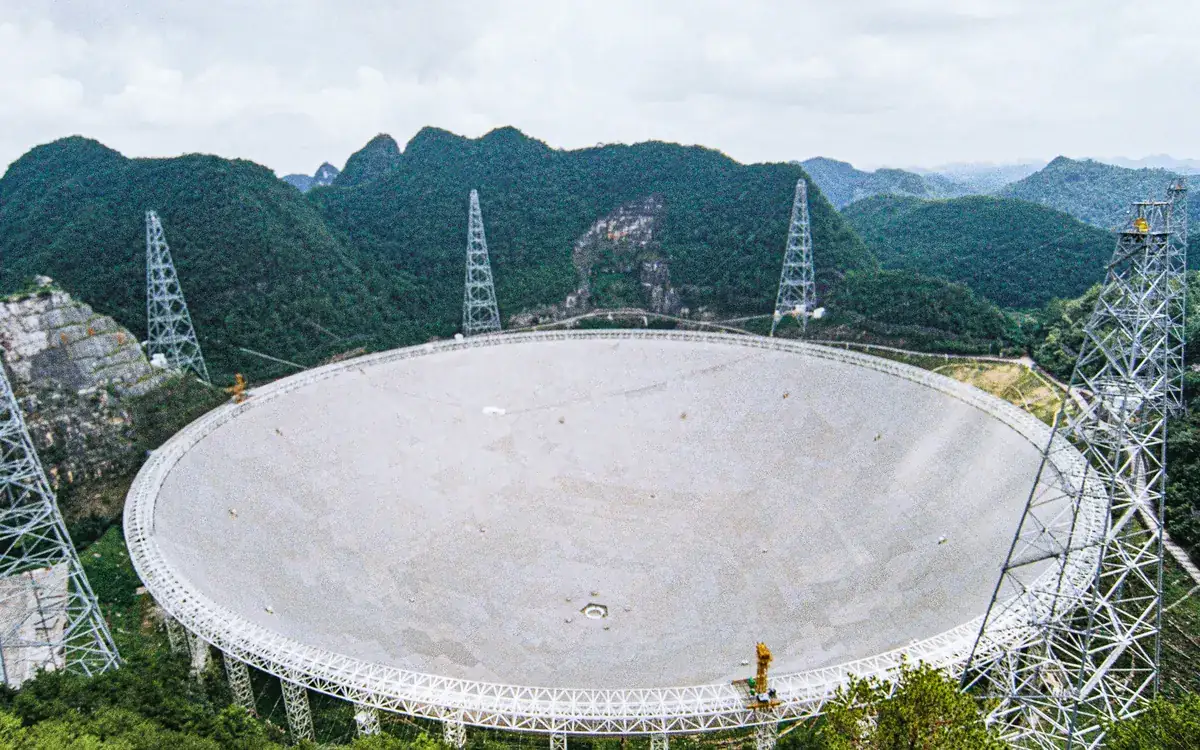
Astronomers using China's Five-hundred-meter Aperture Spherical radio Telescope (FAST) have found a small, round cloud of hydrogen gas sitting alone in space with no visible stars. The study, led by Jin-Long Xu of the National Astronomical Observatories of China and posted as a preprint on arXiv, argues that the object, J1351+0039, could be one of the cleanest examples yet of a so-called dark galaxy, as Phys.org reports.
What is a dark galaxy?
In the standard model of cosmology, galaxies grow inside clumps of dark matter called halos. Theory predicts that some small halos never formed stars at all. After the early universe was reionised, ultraviolet light from quasars and galaxies kept their gas too warm to collapse. Astronomers call these objects RELHICs (reionisation-limited H I clouds), or dark galaxies.
Because they have no stars, they can only be spotted through the faint 21-centimetre radio signal from neutral hydrogen. That is why a huge radio dish like FAST is the right tool. According to the paper, only one RELHIC has been confirmed so far, plus two promising candidates.
What the team found
J1351+0039 turned up in a blind hydrogen survey. The team then observed it three times between July and August 2026 to get high-quality data:
- Gas: about 500,000 solar masses of neutral hydrogen.
- Total mass: about 130 million suns, based on how the gas moves, so most of the mass must be dark matter.
- No stars: deep images from the DESI Legacy Survey show no optical counterpart.
- Alone: no large galaxy lies within 1.5 degrees on the sky (under 100 kiloparsecs at its distance), and there are no tails, bridges or companions. That rules out gas pulled out of another galaxy by gravity.
- Warm and round: the gas sits at about 10,000 K, in balance with the cosmic UV background, consistent with what theory expects for a cloud that never cooled enough to make stars.
The cloud barely rotates, about 4.2 km/s, while its gas moves randomly at about 11.6 km/s. So it is held up by gas pressure rather than spin, unlike normal disc galaxies.
Why it matters and what comes next
Earlier dark galaxy candidates sat near big galaxies, which made their origin harder to read. A truly isolated one is a cleaner test of how dark matter halos form. The authors note one caveat: a very faint dwarf galaxy could still hide below the DESI detection limit, so deeper images from the Hubble or James Webb space telescopes are needed to confirm it is truly starless.
Faint signals in "empty" sky are a theme this month; see Webb's mystery infrared line in the Ultra Deep Field. If you want to explore the sky yourself, start with our beginner telescope guide.
More from Science & Space
View all →Read next

OnePlus Ace 7's fan blows two ways to keep your hands cool
OnePlus says the Ace 7 series' built-in fan splits its airflow between the chip and the back panel and keeps hot air off your fingers. Why that detail matters.

Switch Sports Resort lands Oct 22: what's in all 12 sports
The Switch 2 exclusive Switch Sports Resort arrives on 22 October with 12 motion-control sports on Wuhu Island, including Skateboarding and Thumb Wrestling.

UGREEN ID500 Pro is a Matter camera that records locally
UGREEN's 4K pan-tilt ID500 Pro streams and moves over Matter 1.5.1 and records to its new HomeAgent hub. Early-bird prices, what it needs and when it ships.