Hubble spots a gravitational lens to prepare for NASA's Roman telescope
A new Hubble image shows a galaxy 4.5 billion light-years away bending light from one 8 billion light-years away, part of the groundwork for Roman's dark matter studies.
LandGadget Newsroom · · 3 min read
On this page
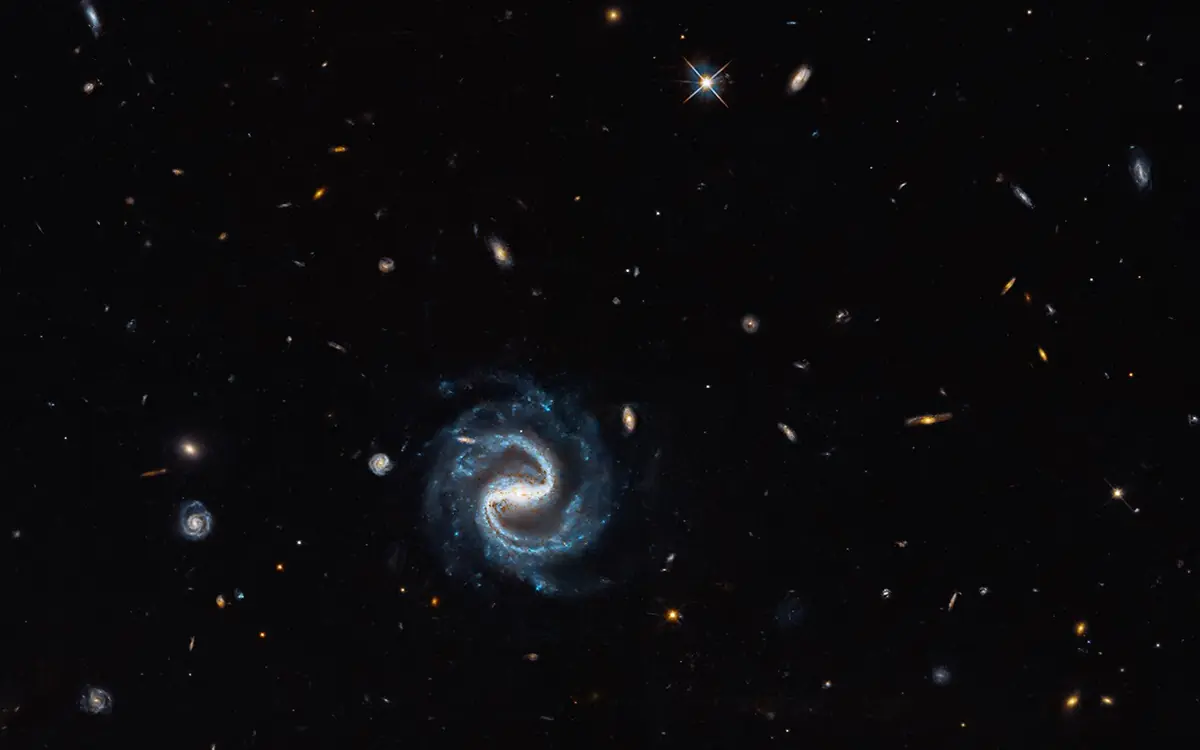
NASA has released a new Hubble Space Telescope image that looks, at first glance, like a portrait of a big spiral galaxy. The real target, though, sits in the lower-right corner: a gravitational lens, where one galaxy magnifies and distorts the light of another far behind it.
What a gravitational lens is
When a massive object such as a galaxy sits almost exactly between us and a more distant galaxy, its gravity warps spacetime and bends the background light around it, a bit like a giant lens. The alignment has to be a precise chance line-up, so such lenses are rare.
What this image shows
- The foreground lens is an elliptical galaxy about 4.5 billion light-years away. NASA notes its light set off towards us around the time our solar system was forming.
- The background galaxy is about 8 billion light-years away, almost twice as far.
- It appears as two arcs: a large, obvious one to the upper left of the lensing galaxy and a much smaller, flipped copy to the lower right. Astronomers call this an arc-counterarc pair.
The large barred spiral that dominates the frame is about the size of our Milky Way, and the tiny spiral to its left may be a satellite galaxy, much like the Magellanic Clouds around our own. Almost everything else in the frame is a galaxy too, apart from a few foreground stars.
Why it matters: weighing dark matter
The more massive the lensing galaxy, the more it bends light. By measuring how the background galaxy is distorted, researchers can work out how much mass the foreground galaxy holds. The visible stars and gas aren't enough to explain the distortion, which lets astronomers estimate how much dark matter the galaxy contains.
Getting ready for Roman
This is one of many lensing images Hubble is taking ahead of the Nancy Grace Roman Space Telescope. The two complement each other: Hubble mainly sees visible and ultraviolet light with sharp views of single objects, while Roman works mostly in the infrared with a much wider field of view. Hubble can only study these lenses one at a time; Roman's wide surveys should find far more of them.
Astronomers are using Hubble's sharp images to build a computer model for analysing dark-matter distortions, a tool meant to help process Roman's huge images. Hubble will also follow up interesting lenses that Roman finds.
For more deep-space news, see our story on Webb's early look at supernova AT 2026abck. Want to see galaxies yourself? Our beginner telescope guide explains where to start.
More from Science & Space
View all →Read next

1Password for Agents: AI can sign in without your password
1Password's new Agents platform lets AI assistants like Meta's Muse log in on your behalf after you approve, filling credentials the agent never sees or keeps.

Atari VCS store closes Feb 1, 2027, but consoles keep working
Atari will shut the VCS software store on February 1, 2027, then ship an OS update that removes server checks and add a homebrew app so the console lives on offline.

iPhone Duo reviews: the best foldable, with trade-offs
Reviewers agree the iPhone Duo is the most polished foldable so far, but flag Touch ID, weight, app support and cameras. Gurman says Duo 2 tests Face ID.