Scientists create tiny ball lightning in the lab
Physicists in China made a glowing plasma ball that behaves like an electromagnetic soliton, a leading idea for what ball lightning is. Here is how it works.
LandGadget Newsroom · · 3 min read
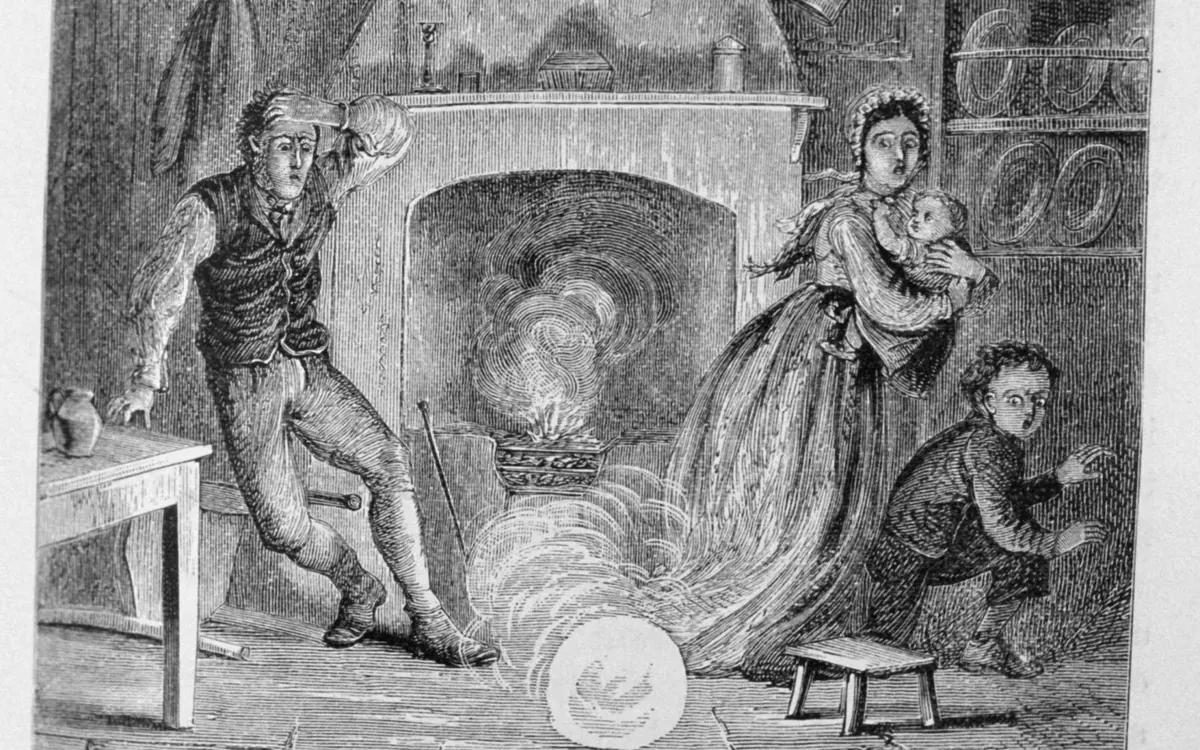
Ball lightning is one of weather's strangest stories: glowing spheres seen drifting near the ground during storms, then vanishing, sometimes with a pop. There are thousands of eyewitness accounts but almost no measurements, because nobody can predict where it will appear. A team in China has now taken the opposite route and made something like it on purpose, in a lab, ScienceAlert reports.
What the team did
Physicist Chuliang Zhou and colleagues at the Chinese Academy of Sciences describe the experiment in Nature Photonics. They fired an ultrashort laser pulse at a tungsten needle with a tip only about 100 nanometres across, roughly a thousand times thinner than a human hair. That launched a powerful electromagnetic wave along the needle. At the tip, the energy concentrated into an intense terahertz electric field that ripped electrons from atoms in surrounding argon gas, creating a small bubble of plasma.
The result was a tiny ball of light. It started about 80 micrometres wide and grew to several hundred micrometres over roughly 100 nanoseconds. That sounds brief, but it is far longer than the pulse that created it, and the sphere kept its structure as it expanded instead of simply fizzling out like ordinary hot gas.
Why "soliton" matters
A soliton is a self-contained wave that holds its shape because competing forces balance out. One long-standing theory says ball lightning is an electromagnetic soliton: energy trapped inside a shell of plasma. The team compared how their sphere grew and cooled, using light filtered at six wavelengths, with theory and simulations. The expansion matched a soliton model, while simulations of ordinary plasma predicted faster and messier spreading. In their words, it is "the first controlled generation of a macroscopic, long-lived soliton driven by relativistic terahertz electromagnetic fields".
Does this solve ball lightning?
Not yet. A sub-millimetre dot in argon is a long way from a fireball in a thunderstorm. Scaling up their models, the researchers estimate that solitons driven by microwaves rather than terahertz waves could, in theory, grow to metres across and last seconds, much closer to what witnesses describe. That remains a calculation, not an observation. The authors also see possible uses in energy storage and in studying how light and matter behave under extreme fields.
Science still has a few of these "we see the effect, not the cause" puzzles; dark matter is the biggest, and our dark matter explainer shows how researchers chase something they cannot observe directly. If storms and night skies are more your thing than lab physics, try our night-sky phone photography guide.
Image: a 19th-century engraving of a ball lightning sighting, shown for illustration.
More from Science & Space
View all →Read next
RTX Remix 1.6 adds DLSS 5, Minecraft beta and Windows on Arm
NVIDIA's RTX Remix 1.6 brings DLSS 5 neural rendering, up to 6x Multi Frame Generation, a Minecraft Java beta mod and Arm support for Portal RTX and more.

Steam Personal Calendar leaves Labs: release dates for you
Steam's Personal Calendar is now a full feature: an 8-week list of upcoming releases picked from your playtime, with wishlist, DLC and Early Access filters.

Does a smart home work without internet? Local control
What keeps working when your internet goes down: cloud vs local control, how Matter, Zigbee and Thread help, and how to build one that survives outages.