What is dark matter? The evidence, the suspects and the search, explained
What is dark matter, how do we know it exists and what could it be? A plain-English guide to the evidence, WIMPs, axions, black holes, MOND and the experiments hunting it.
LandGadget Newsroom · · 8 min read
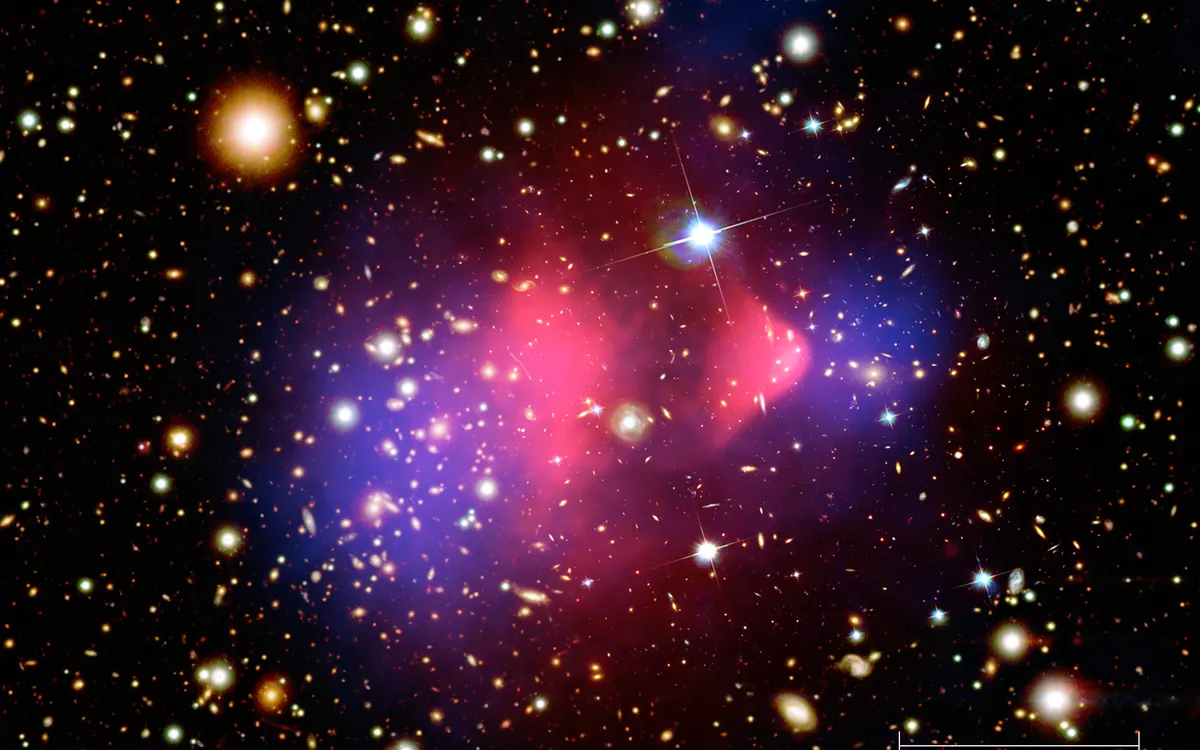
Everything you can see, from your phone to the stars, is made of ordinary matter. Yet astronomers are confident that this visible stuff is only a small fraction of what is out there. Most of the matter in the universe seems to be something we can't see at all: dark matter.
This guide explains what dark matter is, why scientists think it exists, what it might be made of and how the search is going. It is a living topic: we update it when major results come in, like this week's study ruling out black holes heavier than galaxies as a big part of it.
Dark matter in one paragraph
Dark matter is matter that has mass and gravity but does not interact with light. It doesn't shine, doesn't absorb light and doesn't reflect it, so telescopes can't see it directly. We know it is there only because of its gravitational pull on things we can see. According to measurements of the early universe by the European Space Agency's Planck mission, ordinary matter makes up only about 5% of the universe's total energy content, dark matter about 27% and dark energy the remaining 68% or so. In other words, there is roughly five times more dark matter than ordinary matter.
How do we know it's there?
No single observation proves dark matter exists. The case is strong because many independent lines of evidence point the same way.
1. Galaxy clusters move too fast
In 1933 Swiss astronomer Fritz Zwicky measured how fast galaxies were moving inside the Coma Cluster. They were moving far too quickly to be held together by the gravity of the visible galaxies alone. He suggested there must be a large amount of unseen "dark matter" holding the cluster together.
2. Galaxies spin too fast at the edges
In the 1970s Vera Rubin and Kent Ford measured how fast stars and gas orbit in spiral galaxies. If most of a galaxy's mass were in its bright centre, outer stars should orbit more slowly, the way outer planets orbit the Sun more slowly. Instead, the speeds stayed roughly flat far out into the galaxy's edges. The simplest explanation: each galaxy sits inside a much larger, invisible halo of dark matter. Our own Milky Way is thought to have one.
3. Gravity bends light more than it should
Mass bends light, an effect called gravitational lensing. By measuring how background galaxies are distorted, astronomers can map where the mass in a cluster is, whether it glows or not. These maps consistently show far more mass than the visible stars and gas can account for. Telescopes like Hubble and the new Nancy Grace Roman Space Telescope use lensing as a key tool, and it can produce striking images such as this gravitational lens arc.
4. The Bullet Cluster
The cover image shows the Bullet Cluster, two galaxy clusters that smashed through each other. X-ray telescopes show where the hot gas, most of the clusters' ordinary matter, ended up (pink). Lensing shows where most of the mass is (blue). They are in different places. The gas slowed down in the collision, but the bulk of the mass passed straight through. That is exactly what you'd expect if most of the mass is dark matter that barely interacts, and it is hard to explain by simply changing the laws of gravity.
5. The baby picture of the universe
The cosmic microwave background (CMB) is light released about 380,000 years after the Big Bang. Tiny temperature differences in it, mapped in detail by NASA's WMAP and ESA's Planck missions, encode how much ordinary and dark matter existed then. The pattern fits a universe with about five times more dark matter than ordinary matter. Computer simulations also show that without dark matter, galaxies would not have had time to form in the way we observe.
What dark matter is not
- Not ordinary dark gas or dust. Gas and dust absorb and emit light at some wavelengths, and the CMB and the abundance of light elements limit how much ordinary matter exists.
- Not dark energy. Despite the similar name, dark energy is a different mystery. Dark matter pulls things together through gravity. Dark energy is whatever is making the expansion of the universe speed up, discovered in 1998 from distant supernovae.
- Not antimatter. Antimatter meeting matter would produce gamma rays that we would see.
- Not (mostly) neutrinos. Neutrinos are real, invisible particles, but they are too light and fast-moving to build galaxies the way we see. Most models call for "cold", slow-moving dark matter.
The main suspects
| Candidate | What it is | Status |
|---|---|---|
| WIMPs | Weakly interacting massive particles, heavier than protons, predicted by some extensions of particle physics | Searched for for decades; no confirmed signal, and many models are ruled out |
| Axions | Extremely light hypothetical particles first proposed to solve a puzzle in nuclear physics | Being hunted with sensitive microwave cavities and magnets |
| Primordial black holes | Black holes formed in the first moments after the Big Bang, not from dying stars | Most mass ranges are constrained; an asteroid-mass window remains open |
| Sterile neutrinos | A heavier, hypothetical cousin of ordinary neutrinos | Searched for via faint X-ray signals; nothing confirmed |
| Something else | "Dark sectors" with their own forces, dark photons and other ideas | Active theory work |
The black hole option keeps getting narrower. Studies of microlensing, the CMB and other data have ruled out many sizes; the latest work found that stupendously large black holes, over 100 billion solar masses, can't be a major part of dark matter. Tiny, asteroid-mass ones are still on the table.
How scientists are hunting it
There are three main approaches:
- Direct detection. Huge tanks of liquid xenon or other materials sit deep underground, shielded from cosmic rays, waiting for a dark matter particle to bump into an atom. Leading experiments include LZ in South Dakota, XENONnT in Italy and PandaX in China. So far none has seen a convincing signal, which has ruled out large parts of the WIMP landscape.
- Making it. Particle colliders such as CERN's Large Hadron Collider look for collisions where energy seems to go missing, a possible sign of invisible particles being produced.
- Indirect detection. Telescopes look for gamma rays, antimatter or neutrinos that might come from dark matter particles annihilating or decaying in places where dark matter should be dense, such as the centre of our galaxy.
Meanwhile astronomers keep mapping dark matter on cosmic scales. ESA's Euclid space telescope, launched in 2023, and ground-based surveys such as the Vera C. Rubin Observatory measure the shapes of billions of galaxies to chart dark matter through weak lensing. Radio telescopes also look for oddities like starless dark galaxies: a recent example is a lone hydrogen cloud found by China's FAST telescope.
What if there's no dark matter at all?
A minority of physicists argue that instead of invisible matter, our theory of gravity needs adjusting at very low accelerations. The best-known idea is MOND (Modified Newtonian Dynamics), proposed by Mordehai Milgrom in 1983. MOND predicts the rotation of individual galaxies remarkably well. It struggles, however, with galaxy clusters, the Bullet Cluster and the detailed pattern of the CMB, which is why most cosmologists still favour dark matter. The debate is useful: every new measurement tests both ideas.
Can you "see" dark matter yourself?
Not directly, and no amateur telescope will show it. But you can see its effects indirectly: every galaxy you look at through a beginner's telescope is thought to sit inside a dark matter halo several times larger and heavier than its visible disc.
Frequently asked questions
What is dark matter in simple terms?
Dark matter is matter that has mass and gravity but does not give off, absorb or reflect light, so it is invisible to telescopes. We detect it only through its gravitational pull on stars, galaxies and light.
How much of the universe is dark matter?
About 27% of the universe's total energy content, according to Planck measurements. Ordinary matter is about 5% and dark energy about 68%, so dark matter makes up roughly 85% of all matter.
Has dark matter ever been detected directly?
No. Underground detectors such as LZ, XENONnT and PandaX have not found a confirmed dark matter particle. Its existence is inferred from its gravitational effects.
What is the difference between dark matter and dark energy?
Dark matter pulls things together through gravity and helps hold galaxies together. Dark energy is the unknown cause of the universe's accelerating expansion. They are separate mysteries.
Could dark matter be black holes?
Only partly, if at all. Observations rule out most black hole sizes as the main ingredient, including black holes heavier than galaxies. Very small, asteroid-mass primordial black holes are still possible.
Is it possible dark matter doesn't exist?
Some physicists propose modified gravity, such as MOND, instead. It explains galaxy rotation well but struggles with galaxy clusters, the Bullet Cluster and the cosmic microwave background, so most scientists still favour dark matter.
More from Science & Space
View all →Read next

Cyberpunk 2077 update 2.5: dual wielding, mods and an Edgerunners 2 gig
CD Projekt Red's free Edgerunners 2 Update (2.5) adds dual-wielded pistols, cross-platform mods via mod.io, cyberware styling and a prequel quest to the new anime.

How to buy a used graphics card safely: a 2026 checklist
How to buy a used graphics card without getting burned: where to buy, fair prices, seller questions, physical checks, stress tests, fake GPUs and warranty.

How to spot fake apps on Google Play before you install
Fake WhatsApp, Chrome and banking apps keep slipping onto Google Play. Learn the checks that expose a clone: developer, downloads, reviews, ads, permissions, Play Protect.