NASA's Psyche fires its thrusters almost nonstop toward the asteroid belt
After its Mars flyby, NASA's Psyche now runs its xenon Hall thrusters about 90% of the time to reach metal-rich asteroid Psyche by summer 2029. How it works.
LandGadget Newsroom · · 3 min read
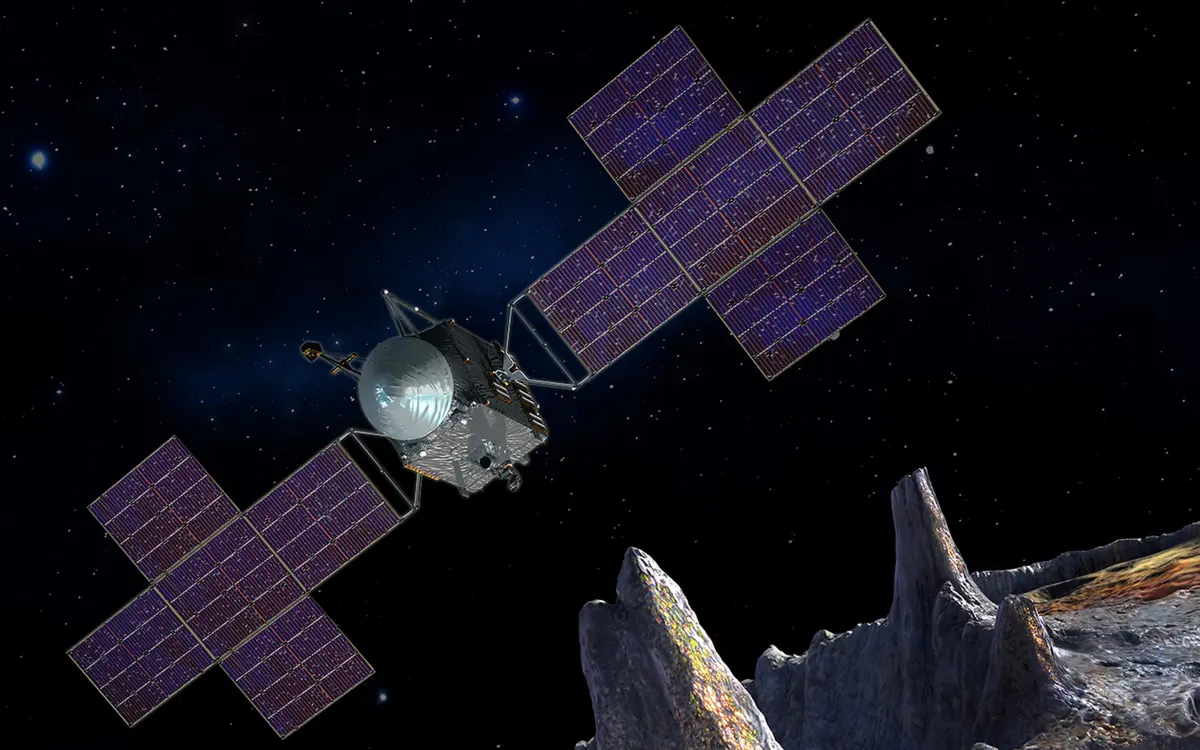
NASA's Psyche spacecraft has moved from careful steering to a long, steady push. After a gravity assist at Mars, the probe started running its electric propulsion system almost continuously on 28 September, NASA said in a mission update on 22 October. It now pauses only about once a week to check in with mission controllers, keeping it on course to reach the metal-rich asteroid Psyche in the main asteroid belt by summer 2029.
"It's now 'pedal to the metal' to the asteroid Psyche," said Don Han, the mission's navigation lead at NASA's Jet Propulsion Laboratory. He said the thrusters will run nearly 90% of the time from now until arrival.
A gentle push that adds up
Psyche does not use chemical rockets for cruise. Its solar-powered Hall-effect thrusters use electric and magnetic fields to accelerate ions of xenon gas, which produces a faint blue glow and up to 250 millinewtons of thrust. NASA compares that to the weight of a single AA battery in your hand. Only one of the four thrusters runs at a time, but the force never really stops, so the speed builds. At its fastest, Psyche will be moving at more than 160,000 km/h relative to Earth.
The power comes from two cross-shaped solar arrays with about 75 square metres of collecting area. Psyche launched in October 2023 with about 1,090 kg of xenon in seven tanks and has used roughly a third of it, which leaves enough for the cruise and the two-year science mission in orbit.
Sunlight is the limit. Steve Snyder, JPL's lead engineer for propulsion operations, said the spacecraft will thrust at full power for about three months, then slowly throttle down to around half power as it moves away from the Sun and its arrays produce less electricity.
A twist engineers can only measure in space
Even this gentle thrust needs constant management. The swirling ions create a tiny twisting force that would slowly turn the spacecraft. Reaction wheels absorb it, and the team periodically unloads the built-up momentum by briefly firing a different thruster. Snyder said this is the first time anyone has measured this effect on a Hall thruster across different power levels and over such a long time in space.
Why Psyche matters
The asteroid is about 280 km across at its widest and may be part of the metal core of a planetesimal, an early building block of planets. If so, it offers a rare look at the kind of core that is buried deep inside rocky worlds like Earth.
For more space news, see how NASA's Roman Space Telescope entered science commissioning and how ESA's Euclid found its first comet. If you want to look up yourself, our beginner telescope guide explains where to start.
More from Science & Space
View all →Read next
Cyberpunk 2077 update 2.5: dual wielding, mods and an Edgerunners 2 gig
CD Projekt Red's free Edgerunners 2 Update (2.5) adds dual-wielded pistols, cross-platform mods via mod.io, cyberware styling and a prequel quest to the new anime.
How to choose a graphics card: a practical GPU buying guide
How to choose a graphics card: match it to your monitor, pick enough VRAM, check your power supply and case, compare Nvidia, AMD and Intel, and buy used safely.
How to spot fake apps on Google Play before you install
Fake WhatsApp, Chrome and banking apps keep slipping onto Google Play. Learn the checks that expose a clone: developer, downloads, reviews, ads, permissions, Play Protect.