Chandra solves the cosmic ‘Treble Clef’ radio mystery
A radio structure shaped like a treble clef was likely made by a black hole outburst, then re-energised when two galaxy clusters collided, Chandra data suggest.
LandGadget Newsroom · · 2 min read
On this page
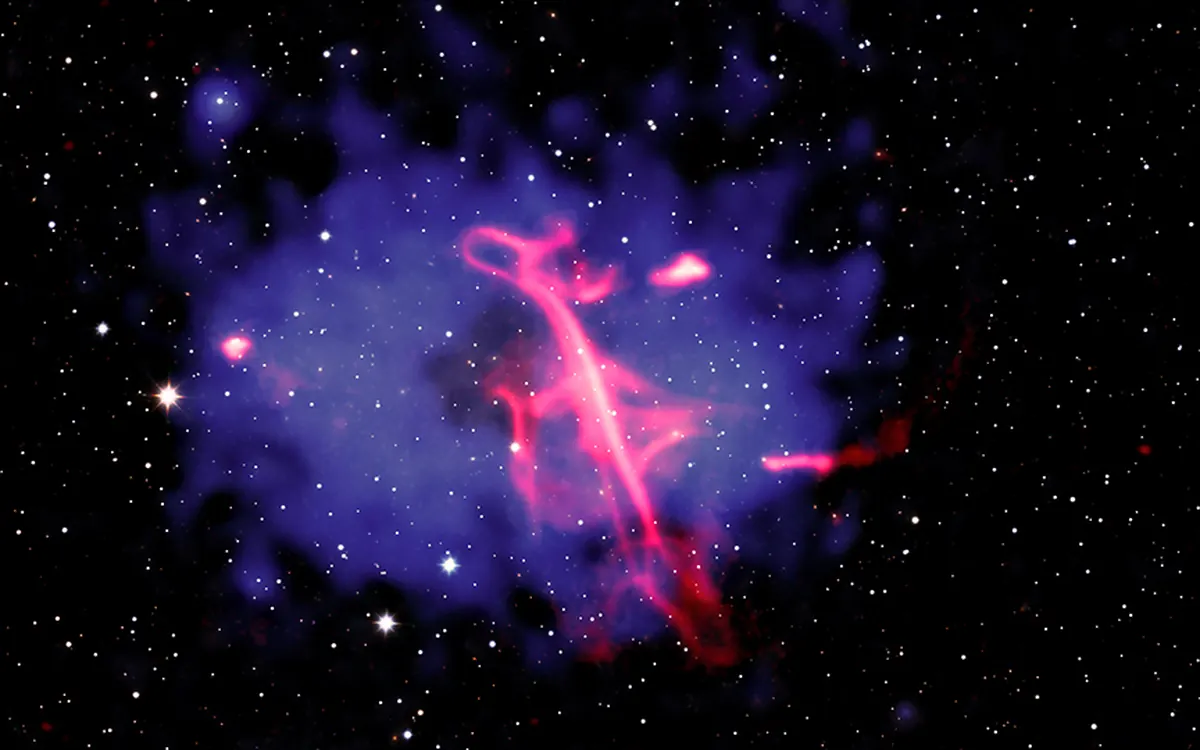
Astronomers have worked out what is behind one of the stranger shapes in the radio sky. Nicknamed the “Treble Clef” because it looks remarkably like the musical symbol, the structure (catalogued as VLSS J0318.9+5755) was probably created by a supermassive black hole outburst followed by a collision of two galaxy clusters, according to a release from NASA’s Chandra X-ray Center. The study, led by Andrea Botteon of Italy’s National Institute for Astrophysics (INAF), was published in Astronomy & Astrophysics.
A hard object to see
The Treble Clef lies almost directly behind the plane of the Milky Way, so stars, gas and dust in our own galaxy block much of the view. To get around that, the team combined telescopes that can see through the clutter:
- Chandra and the German eROSITA X-ray telescope found diffuse, multimillion-degree gas at the location, proving that a galaxy cluster hosts the object, and in fact two clusters that are merging.
- LOFAR, the European radio array, shows the treble clef itself (pink in the image).
- Infrared data from the United Kingdom Infrared Telescope add the stars and galaxies, mostly in white.
Chandra puts the system about 1.55 billion light-years from Earth, and the image spans about 6 million light-years.
A two-stage “crescendo”
The researchers propose a two-step story. First, an earlier outburst from the black hole at the cluster’s centre drove clouds of charged particles and magnetic fields away at close to the speed of light. These glowed brightly in radio waves, then faded as the particles lost energy. Later, the collision between the two clusters compressed or re-energised the cloud, making it bright again. Shock waves from the merger may have helped.
To find evidence for the crash, the team subtracted the smooth, oval shape of the hot gas from the X-ray image. The leftover emission is brightest to the left and right of the centre, suggesting the clusters collided along that line a few hundred million years ago and are now moving apart.
The musical likeness is pure pareidolia, the tendency to see familiar shapes in random patterns. Some see a dragon viewed from the side instead.
For more deep-sky puzzles, read about Webb’s mystery emission in the Hubble Ultra Deep Field, or start observing yourself with our beginner telescope guide.
More from Science & Space
View all →Read next

Sony cancels the promised Android 17 update for Xperia 10 VI
Sony says storage limits block an adequate Android 17 upgrade on the midrange Xperia 10 VI. Security patches should continue through June 2028.

Withings now charges new users for Apple Health sync
New Withings accounts created from 13 October need Withings+ ($9.95/month or $99.50/year) to auto-sync to Apple Health and Health Connect; older ones stay free.

Resident Evil 2, 3 and 4 remakes hit Switch 2 today — 6 facts
Capcom’s RE2 Deluxe, RE3 and RE4 Gold are out digitally on Nintendo Switch 2 on Oct 16, 2026; physical discs Jan 29, 2027. Plus Monster Hunter Wilds dated for Dec 4.