JWST and NOEMA find a stellar bar in early-universe galaxy GN20
IRAM reports a stellar bar in GN20 at redshift 4.055 — when the universe was about 1.5 billion years old — challenging classic ideas that gas-rich galaxies cannot form bars quickly.
On this page
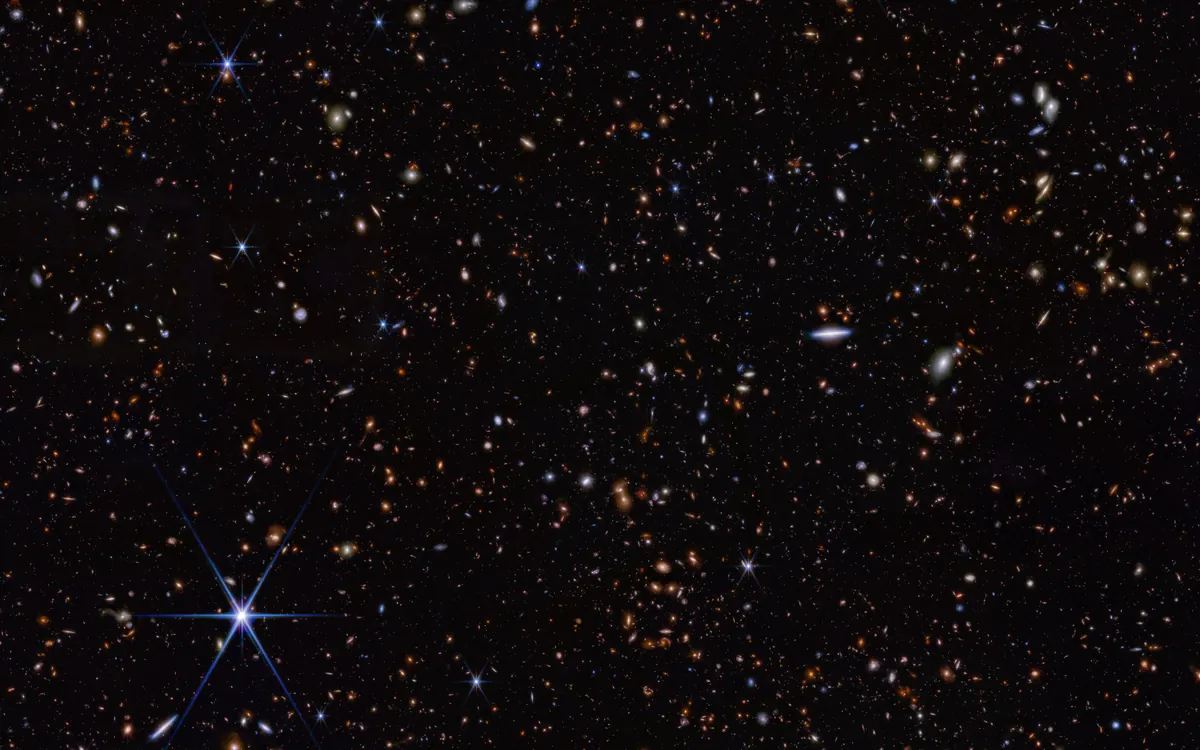
Astronomers using the NOEMA interferometer and the James Webb Space Telescope have found a stellar bar in the early-universe galaxy GN20, IRAM reports. Bars are elongated stellar structures that help funnel gas toward galactic centers; classic thinking said they should not form quickly in extremely gas-rich galaxies like those common in the young universe.
What GN20 is
GN20 is a massive, dusty starburst galaxy at redshift z = 4.055 — seen when the universe was only about 1.5 billion years old (versus roughly 13.8 billion today). Earlier Plateau de Bure and higher-resolution NOEMA observations led by Leindert Boogaard (Leiden), Fabian Walter (MPIA) and collaborators mapped its dust and found a bar-like dust structure plus a huge cold molecular-gas reservoir. A radiative-transfer model with Axel Weiss (MPIfR) independently estimated that GN20 holds nearly three times as much mass in gas as in stars.
What Webb added
JWST’s MIRI instrument peered through heavy dust and revealed a stellar bar aligned with the dust bar, with intense star formation in the center and where the bar meets the disk. Co-author Joss Bland-Hawthorn summarizes the early-universe twist as “the gas is in charge,” unlike nearby galaxies where stars usually drive bar formation.
Why it matters
If bars can form efficiently in gas-rich systems, they could rapidly feed central star formation — and later help shut it down in massive galaxies. Planned NOEMA observations of molecular-gas motions are meant to test whether the bar really transports gas inward. The IRAM note cites companion papers Boogaard et al. 2026a and 2026b in The Astrophysical Journal.
More from Science & Space
View all →Read next

GTA VI launch trailer is live — five weeks to November 19
Rockstar dropped the Grand Theft Auto VI Launch Trailer on 15 October, with new PS5-captured footage and a debut score track, ahead of the 19 November release.
How much RAM do you need in 2026? 8, 16, 32 or 64 GB explained
What RAM does, how to tell if you're running out, and how much memory to get for browsing, office work, gaming, video editing and local AI in 2026.

How to choose wireless earbuds in 2026
Fit, ANC, codecs, battery, multipoint and IP rating: a practical buying guide to true wireless earbuds without invented lab scores or brand rankings.