JWST found a lone infrared line in ‘empty’ Ultra Deep Field sky — twice
Astronomers using NIRSpec slitless spectroscopy spotted a bright ~1.6 μm emission line twice, 88 days apart, where Hubble and JWST images show no source.
LandGadget Newsroom · · 3 min read
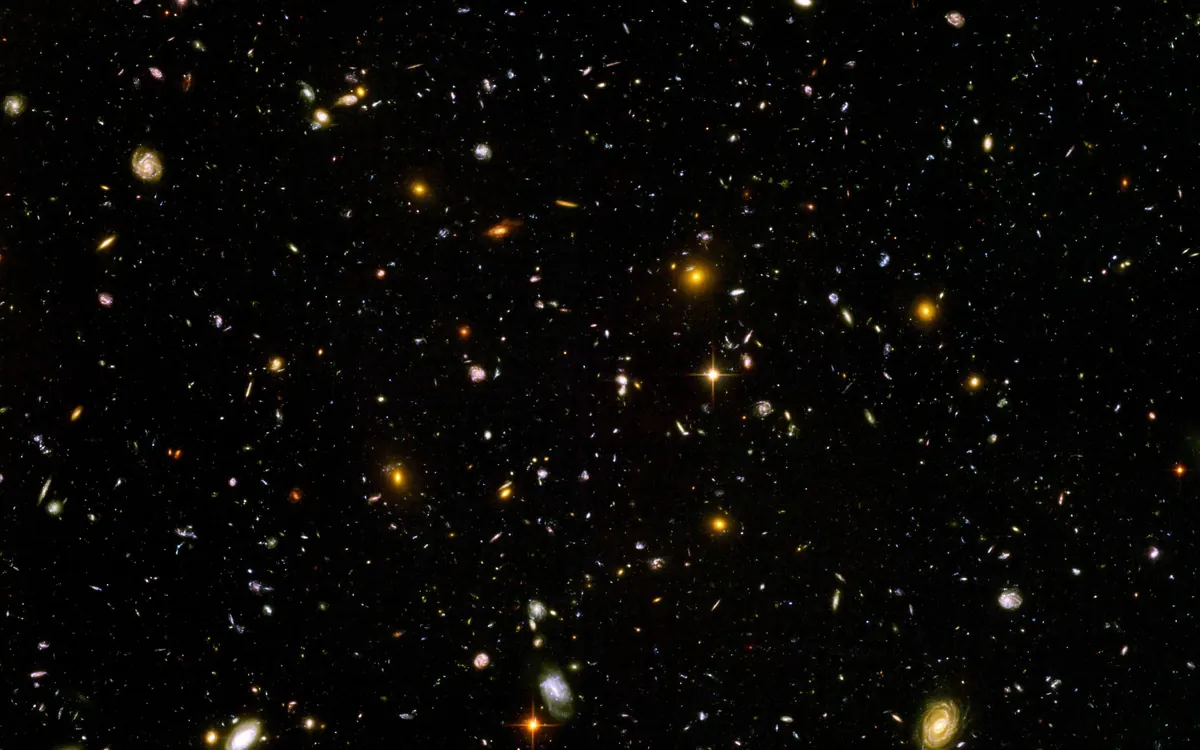
In a famous blank-looking patch of the southern sky — the Hubble Ultra Deep Field (HUDF) in Fornax — the James Webb Space Telescope has picked up a bright near-infrared emission line that does not match any known object in older images. ScienceAlert summarizes a study led by Mason Huberty (University of Minnesota) now in The Astrophysical Journal (DOI 10.3847/1538-4357/ae9a94).
How they looked
Instead of aiming NIRSpec at catalogued galaxies, the team used a slitless-style approach they call MOCSS: they opened nearly all microshutters, closed only those covering known bright foreground sources, and searched the spectra for emission lines. They observed twice — August and November 2023, 88 days apart — at different spacecraft orientations to reduce the chance of a glitch.
Six detections matched known distant galaxies. A seventh did not.
Why it is weird
The mystery signal is a single bright line near 1.6 micrometers. It showed up in multiple exposures across both visits with consistent measurements. Yet deep Hubble and JWST images of that spot — including earlier JADES imaging from October 2022 — show nothing bright enough to explain a line that strong. If the source had been steadily shining during JADES, Webb should have seen it.
Without a redshift (usually fixed by several lines or a continuum), one wavelength could be light from many different distances and processes.
Leading guesses — and why they fail cleanly
The paper walks through candidates:
- An early-universe galaxy — hard for that line to traverse neutral hydrogen, and it should have appeared in JADES
- A nearby galaxy — usually shows more than one line
- A supernova — typically other lines too
- A tidal disruption (black hole shredding a star) — possible with little continuum, but evidence is thin
The authors call the object “highly unusual” and say deeper spectroscopy is needed to pin down redshift and physics.
Frequently asked questions
Is this aliens?
Nothing in the paper claims that. The authors discuss ordinary astrophysical transients and ask for better spectra — standard scientific caution, not sci-fi.
Could it be a telescope glitch?
Unlikely to be a one-off artifact: the line appeared in four combined exposure sets across two orientations months apart with matching measurements.
For space fans, it is a reminder that even the best-studied square of sky can still surprise when you change the instrument mode — and that “empty” often only means “empty at the wavelengths we already checked.”
More from Science & Space
View all →Read next

Resident Evil 2, 3 and 4 remakes hit Switch 2 today — 6 facts
Capcom’s RE2 Deluxe, RE3 and RE4 Gold are out digitally on Nintendo Switch 2 on Oct 16, 2026; physical discs Jan 29, 2027. Plus Monster Hunter Wilds dated for Dec 4.

How much RAM do you need in 2026? 8, 16, 32 or 64 GB explained
What RAM does, how to tell if you're running out, and how much memory to get for browsing, office work, gaming, video editing and local AI in 2026.

How to choose wireless earbuds in 2026
Fit, ANC, codecs, battery, multipoint and IP rating: a practical buying guide to true wireless earbuds without invented lab scores or brand rankings.