NASA's Moon Base rovers: VIPER ready, crewed LTVs due end of 2027
NASA says VIPER is built and in final testing for a 2027 South Pole trip, while Astrolab and Lunar Outpost aim to deliver crewed lunar rovers by end of 2027.
LandGadget Newsroom · · 3 min read
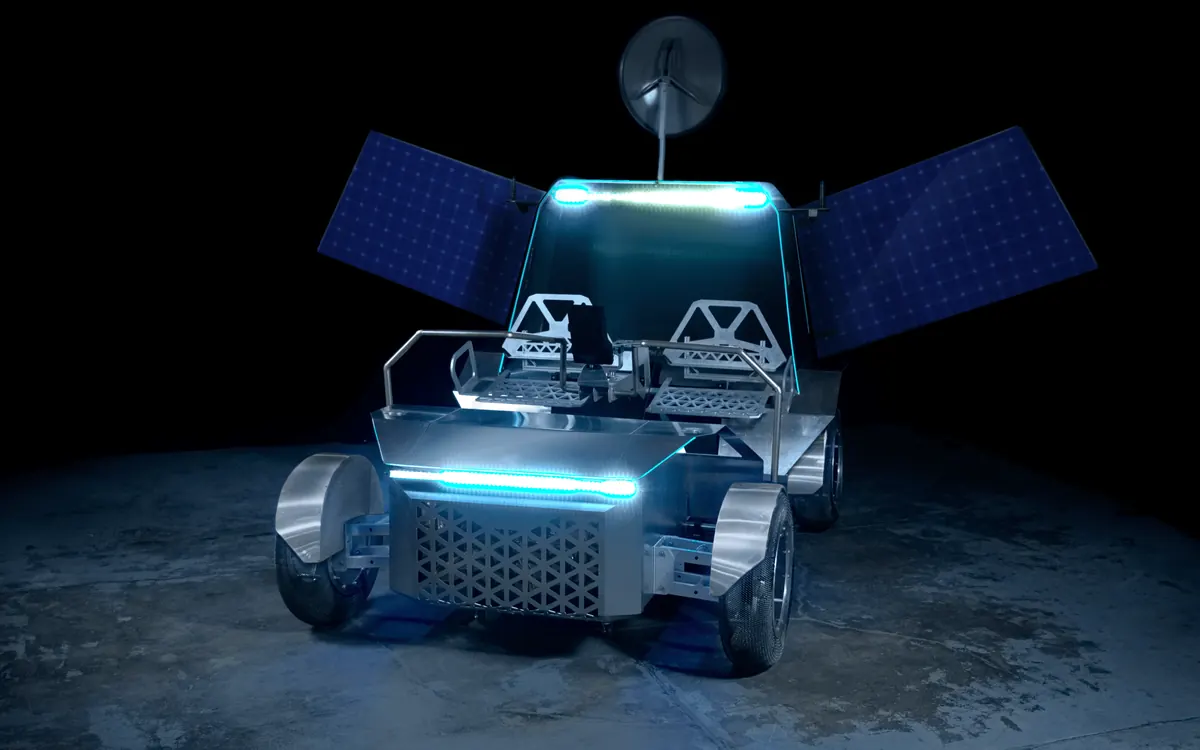
NASA has given a progress update on the rovers for its Moon Base, the outpost it plans near the lunar South Pole. One robotic rover is built and close to shipping, and two companies are racing to finish crewed "lunar terrain vehicles" (LTVs) that will first drive themselves, remotely controlled from Earth, before astronauts arrive.
VIPER: built, testing, flying in 2027
VIPER (Volatiles Investigating Polar Exploration Rover) is fully built and in final testing at NASA's Johnson Space Center in Houston. Next it moves to Kennedy Space Center for launch in 2027 on a Blue Moon Mark 1 lander. On the Moon it should drive more than 30 km, venturing into permanently shadowed craters to look for water and other resources a long-term base could use. Mission control will sit at NASA Ames in Silicon Valley, where teams are already rehearsing scenarios.
Crewed rovers from Astrolab and Lunar Outpost
NASA picked Astrolab and Lunar Outpost to build the first phase of crew-carrying LTVs, and Blue Origin to deliver them to the South Pole region by 2028. Before crews land, the rovers will be driven from Earth for up to 6 km a day, mapping terrain and testing how they cope with shadowed areas as cold as minus 203°C. With astronauts aboard, NASA says each LTV can support up to three moonwalks per mission, carry up to 80 kg of samples and tools, and travel up to 10 km per charge.
- Astrolab CLV-1, derived from its FLEX design. NASA astronauts in mock Artemis suits have evaluated a mock-up at Axiom Space. A small robotic precursor, FLIP, rides on Voyager Technologies' Griffin Mission One, due in late 2026, to test tyres, batteries, radios and cameras.
- Lunar Outpost Pegasus, a lighter evolution of its Eagle LTV. A third static mock-up was tested by suited astronauts at Johnson. The company's MAPP rover already operated at the South Pole in 2025, and a second MAPP is set for early 2027.
Both teams head to NASA Glenn in the coming weeks to test their wheels on simulated lunar soil: Astrolab's flexible airless wheels and Pegasus' spring-mesh tyres.
Moon Base rover milestones
2025
MAPP at the South Pole
Lunar Outpost's robotic rover flight-proves systems later used to drive Pegasus remotely.
Oct 2026
Pegasus design review
Lunar Outpost is due to complete its LTV preliminary design review this month.
Late 2026
FLIP launches
Astrolab's robotic testbed flies on Griffin Mission One.
Dec 2026
CLV-1 design review
Astrolab is scheduled to finish its preliminary design review by the end of December.
2027
VIPER and second MAPP
VIPER heads to the South Pole on Blue Moon Mark 1; a second MAPP launches in early 2027.
End of 2027
Flight hardware due
Both companies are on schedule to hand flight-ready LTVs to NASA.
By 2028
LTVs on the Moon
Blue Origin delivers the rovers to the South Pole region ahead of crewed Artemis missions.
The update comes as Europe also reshapes its lunar plans, with ESA's Lunar Link cleared for flight while Gateway is paused. Want to see the South Pole region for yourself? It's not visible in detail from Earth, but our beginner telescope guide will get you great views of the rest of the Moon.
More from Science & Space
View all →Read next

Game Pass late October: Final Fantasy VII Remake, Mouthwashing
Xbox's second October Game Pass wave adds Final Fantasy VII Remake Intergrade, The Séance of Blake Manor and Mouthwashing. Nine games leave on October 31.

POCO X8s: a compact phone with a 6,330 mAh battery
The POCO X8s is up for pre-order in Vietnam before its formal launch: a 6.35-inch OLED, Snapdragon 7 Gen 4, 6,330 mAh battery and 100 W charging from about $437.

Claude designed 17 lab-confirmed binders for scorpion toxins
Anthropic says Claude generated 318,484 protein designs in 64 hours; 17 of 211 lab-tested ones bound scorpion neurotoxins. It is not an antivenom yet.