Hubble and Webb capture the 'Cat's Head Nebula' in Carina
New Hubble and Webb images show a cat-shaped dust pillar in the Carina Nebula, 7,500 light-years away, carved by massive stars and hiding newborn stars inside.
LandGadget Newsroom · · 3 min read
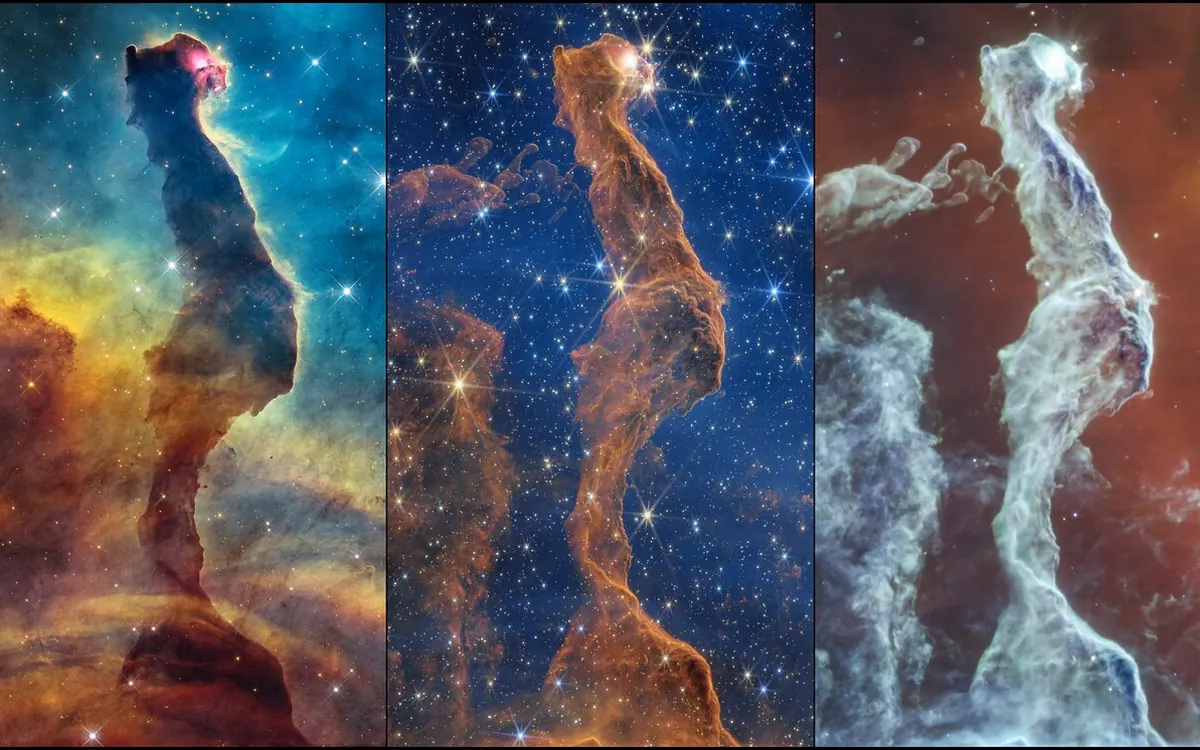
Just in time for Halloween, ESA and NASA have released new images of a star-forming cloud that looks like a cat sitting with its back to us. The Cat's Head Nebula is a small part of the huge Carina Nebula, about 7,500 light-years from Earth. The Hubble Space Telescope and the James Webb Space Telescope both observed it, and their views show very different things.
A pillar shaped by giant stars
According to ESA/Hubble, the cat shape was probably carved over time by ultraviolet radiation and winds from the massive stars in the Carina Nebula. As this "stellar feedback" wears away the surrounding gas and dust, denser material inside the pillar resists for now. The scene is temporary: as new stars form and evolve, it will eventually disperse.
What Hubble sees
In visible light, Hubble shows an opaque, dark brown pillar of dust. The cat's glowing red eye may be a young star still partly buried in dust. A hazy yellow ridge along the right edge is gas being heated and ionised by ultraviolet light from nearby massive stars, which may be slowly evaporating it. Hubble's filters pick up light from oxygen, hydrogen and sulphur, so the surrounding gas glows from blue and cyan at the top to orange and red at the bottom.
What Webb adds
Webb looks in infrared light, which passes through dust far better. In its near-infrared image the pillar becomes more transparent and its surface detail appears, along with a dense field of stars. Some of those stars are still wrapped in dust, the eye is still visible, and faint background galaxies show through our own Milky Way.
The mid-infrared view traces warm dust and carbon-based molecules. It brings out delicate globules and strands on the left of the pillar. To the right sits a bright yellow source that is likely an infant star embedded in dust. A thin filament seems to cross it, though ESA notes the image alone cannot show whether the two are physically linked.
Why two telescopes
Star formation happens inside dust clouds that hide it from visible-light telescopes. Combining Hubble's view of the cloud's surface with Webb's view inside it helps astronomers study how stars form, a process that is still chaotic and not fully understood.
The Carina Nebula is a southern-sky object and lies too far south to see from Ukraine or most of Europe. If you want to explore the sky yourself, our beginner telescope guide and our tips on night-sky photography with a phone are good places to start.
More from Science & Space
View all →Read next

Best Monitor Size for Gaming: 24 vs 27 vs 32 Inch
What monitor size is best for gaming? Compare 24, 27, 32-inch and ultrawide screens by resolution, pixel density, desk distance, GPU power and the games you play.
How to choose a laptop in 2026: a practical buying guide
How to choose a laptop in 2026: pick the right type, then CPU, RAM, storage, screen, battery and ports. Simple rules for students, work, gaming and creative use.
Smart plug buying guide: how to choose one in 2026
Smart plug buying guide: Matter vs Wi-Fi vs Thread, load ratings, energy monitoring, outdoor plugs, local control and what you should never plug in.