NASA TRACERS first results: how solar wind cracks Earth's shield
NASA's twin TRACERS satellites published first results on magnetic reconnection, the process behind geomagnetic storms: it shifts in place rather than in time.
LandGadget Newsroom · · 2 min read
On this page
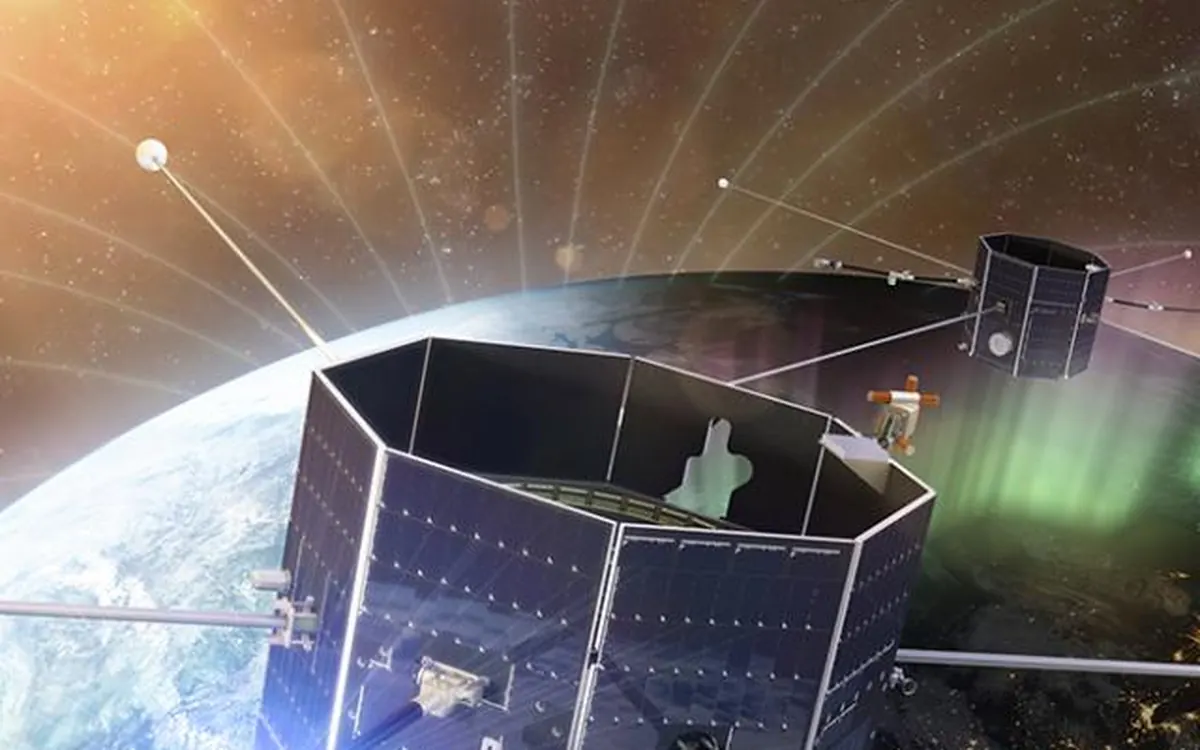
NASA's TRACERS mission has published its first science results, and they shed light on the violent process that lets the Sun's energy break through Earth's magnetic shield. In a paper in the Journal of Geophysical Research, the team reports that magnetic reconnection on the day side of Earth is largely a spatial process, NASA said on 29 October.
What TRACERS studies
The Tandem Reconnection and Cusp Electrodynamics Reconnaissance Satellites are two spacecraft launched last year. They fly one behind the other in a Sun-synchronous orbit and pass through the polar cusps, funnel-shaped regions over the magnetic poles where particles from the solar wind pour down into the upper atmosphere.
That matters because of magnetic reconnection. When the Sun's magnetic field, carried by the solar wind, collides with Earth's magnetosphere at its outer boundary (the magnetopause), energy builds up until field lines snap and reconnect, flinging particles at high speed towards Earth. It is the engine behind many geomagnetic storms and auroras.
What the first data show
Data from the satellites' Analyzers for Cusp Ions instruments suggest that changes the spacecraft see are mostly due to the reconnection site moving, not to the reconnection rate changing over time. Because the two satellites cross the same region a short time apart, the team can compare their readings and tell those two effects apart. NASA notes that future measurements will help confirm the result.
"This is an important first step in understanding how magnetic reconnection works and how these processes can affect Earth," said Stephen Fuselier of the Southwest Research Institute, the mission's deputy principal investigator.
A mission that nearly stumbled
The team had a setback with one of the satellites after launch and had to work to re-establish contact. Both spacecraft now observe the southern cusp several times a day, and in September NASA approved a mission extension into spring 2027. TRACERS is led by David Miles of the University of Iowa.
Why it matters
Better models of reconnection mean better space weather forecasts, which protect astronauts, satellites and power grids. That includes the satellites your phone may use for emergency messages; see our explainer on satellite texting phones. If a storm sparks auroras near you, our night sky phone photography guide explains how to capture them.
More from Science & Space
View all →Read next
What is a normal CPU temperature? Safe ranges and fixes
Normal CPU temperatures at idle, in games and under full load, Intel and AMD limits explained, how to check your CPU temp and 8 ways to keep your processor cooler.
Best Monitor Size for Gaming: 24 vs 27 vs 32 Inch
What monitor size is best for gaming? Compare 24, 27, 32-inch and ultrawide screens by resolution, pixel density, desk distance, GPU power and the games you play.

Bluetooth Codecs Explained: SBC vs AAC vs aptX vs LDAC vs LC3
What Bluetooth audio codecs actually change: SBC, AAC, aptX, LDAC and LE Audio's LC3 compared — sound, latency, battery and which phones support which codec.