Teghaza 001: one of the oldest Mars meteorites ever found
A rose-coloured rock found in the Sahara is a 4.1-billion-year-old piece of Mars crust, a NASA-funded study in Science finds, with clues to water on early Mars.
LandGadget Newsroom · · 3 min read
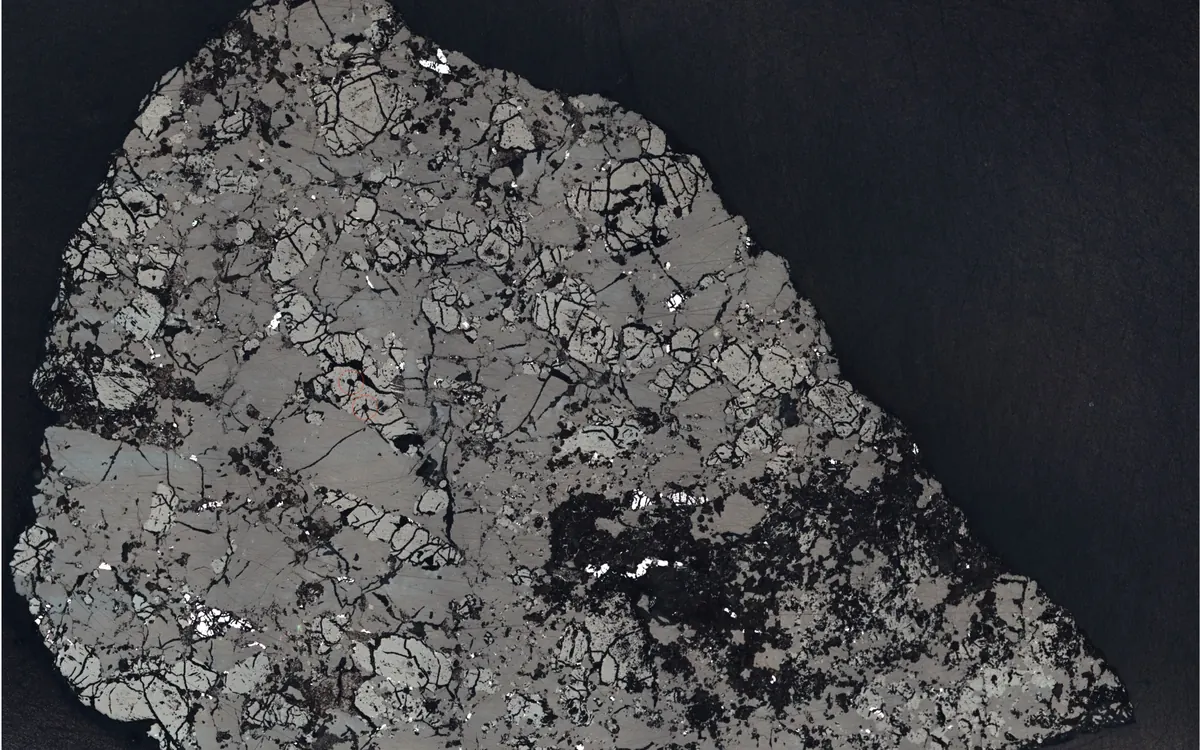
A pinkish stone picked up in the Sahara in 2022 has turned out to be one of the oldest pieces of Mars on Earth. In a paper published on 29 October in Science, NASA-funded researchers describe the meteorite, named Teghaza 001 after the salt plain in Mali where it was found, as a sample of the Red Planet's crust that formed more than 4.1 billion years ago.
What makes it special
The rock weighs about 800 grams (nearly 2 pounds) and is one of roughly 435 known Martian meteorites. According to NASA, it is one of the three most ancient found on Earth. The other two tell a narrower story: ALH84001 is similar in age but consists almost entirely of one mineral, while "Black Beauty" formed about 2.1 billion years ago from small volcanic fragments.
Teghaza 001 instead contains a mix of igneous minerals that records how the crust crystallised from cooling magma and was later altered by underground water. Its mineralogy matches what NASA's Mars Reconnaissance Orbiter sees in the planet's heavily cratered southern highlands. The team identified 13 possible source locations on Mars, though NASA notes that no one will ever know exactly where it came from.
"This is really our first piece of Martian crust from a part of Mars we've never had a sample of before," said co-author Lee Saper, now at NASA's Ames Research Center. Lead author Yang Liu of NASA's Jet Propulsion Laboratory said one reviewer called the rock "a Rosetta Stone for Mars."
How it was dated
Researchers at the University of New Mexico had already confirmed it was Martian from its oxygen isotopes, and it looked like a shergottite, the most common type of Mars meteorite. Liu's team then found zircon crystals, which are ideal for precise dating. Caltech co-author François Tissot helped apply an in-situ rubidium-strontium dating method pioneered by his team. It analyses single mineral grains on a fragment smaller than a fingernail, rather than dissolving a whole sample. That preserves rare material for future work.
The results showed the rock was altered by water about 4.1 billion years ago, so it must have formed even earlier. Oxygen isotopes, texture and chemistry point to a more dynamic water cycle on early Mars. A separate paper in Science Advances in June described its water content.
Why it matters
Meteorites are the only Mars rocks scientists can study in Earth labs until samples are returned. A well-dated piece of the ancient highlands gives researchers a reference point for the period when Mars still had water at or near its surface. For more on Mars science, see our report on Perseverance and Mars dust. If you'd like to look at the planet yourself, our beginner telescope guide explains what you can see.
More from Science & Space
View all →Read next
How to choose a baby monitor: Wi‑Fi vs non‑Wi‑Fi, security
Audio, local video or Wi‑Fi app monitor? How to choose a baby monitor by range, night vision, battery, privacy and security, plus the setup steps that matter.

CPU vs GPU bottleneck explained: how to tell what's slowing your games
What a CPU or GPU bottleneck really is, how to spot one with a performance overlay, why resolution changes everything, and the fixes worth trying before you buy parts.

HDMI vs DisplayPort: which cable should you use in 2026?
HDMI vs DisplayPort explained: HDMI 2.1 and 2.2 vs DisplayPort 1.4 and 2.1 bandwidth, which to use for gaming monitors, TVs, consoles and laptops, plus cables.