Webb catches a possible supernova at redshift 5, just days after the blast
Transient AT 2026abck lies in an unlensed galaxy at z = 5.017. Astronomers say it looks hotter and brighter than a normal Type II supernova this early.
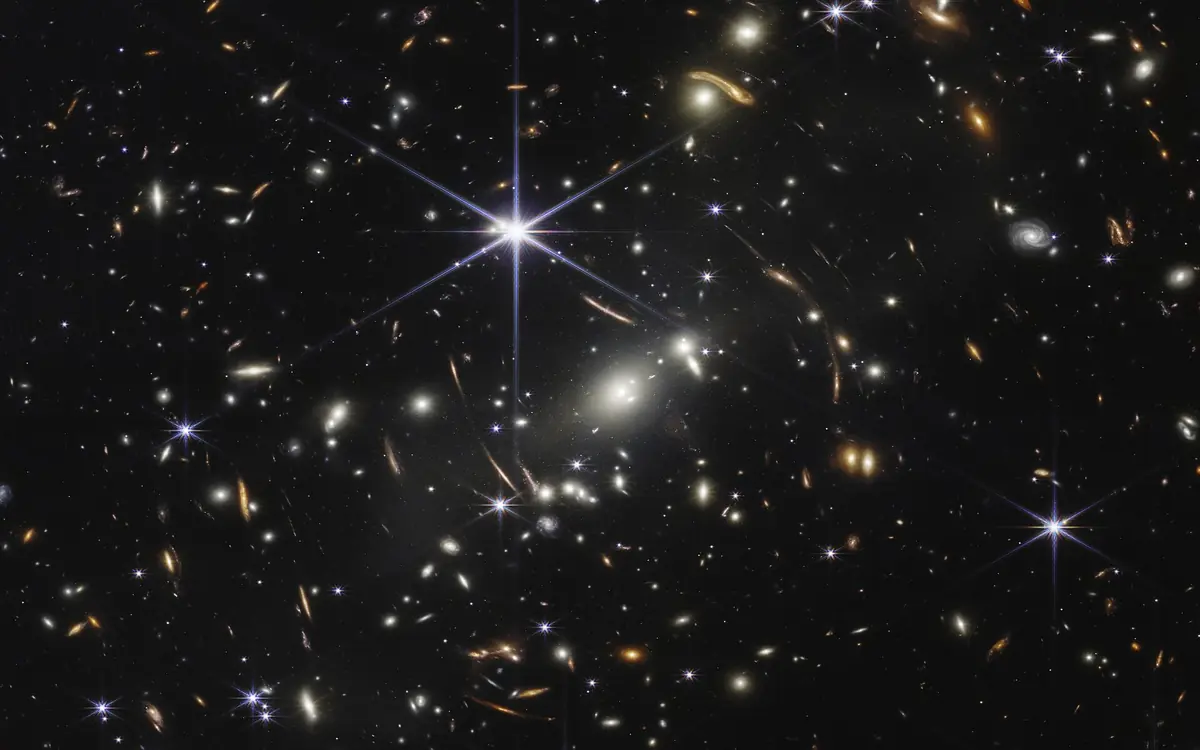
The James Webb Space Telescope has spotted what may be a supernova in the early universe, caught only about four to ten days after the star exploded. The object, named AT 2026abck, sits in a star-forming galaxy at redshift 5.017. That means we see it as it was roughly a billion years after the Big Bang. Unusually, it was found without help from gravitational lensing.
The result comes from a team led by Ming-Yang Zhuang (University of Illinois Urbana-Champaign). Their paper was posted on arXiv on 29 September and reported by Phys.org on 13 October. It has not yet been peer reviewed.
How it was found
The event turned up in NEXUS, a Webb Treasury programme that revisits the same patch of sky about every two months. On 28 May 2026 the spot was empty. Some 71 days later a new source had appeared at about magnitude 27.4, more than 3.6 times brighter in the F200W filter.
Why it stands out
Webb has found more than 200 possible supernovae out to a redshift of about 6. But beyond redshift 4, most were seen only once or a few times, and very few were caught within days of exploding. At redshift above 5, only one supernova has been confirmed with a spectrum, and that one was magnified up to 30 times by a galaxy cluster.
The team's models give AT 2026abck a temperature of about 17,000 K, a radius of about 46 times the Earth–Sun distance and a luminosity of about 3 × 10⁴³ erg/s. It lies about 3,600 and 4,200 light-years from the centres of two parts of its host galaxy. The authors say this makes a star torn apart by a black hole, or a flare from an active galactic nucleus, unlikely. It is also too hot and too bright in ultraviolet for a Type Ia explosion.
What it could be
None of 34 well-observed nearby Type II supernovae was this hot or this bright at a similar age. The best match is a Type II supernova surrounded by dense material shed by the star, which would add extra early light. A superluminous supernova caught on the rise is also possible.
There is no spectrum of the transient yet. The analysis rests on brightness measured in a few filters, so the team is calling for deep NIRSpec spectroscopy. A Type II event should fade quickly in ultraviolet, while a superluminous one would keep brightening.
Want to see deep-sky objects yourself? Start with our beginner telescope guide.
More from Science & Space
View all →Read next

GTA VI launch trailer is live — five weeks to November 19
Rockstar dropped the Grand Theft Auto VI Launch Trailer on 15 October, with new PS5-captured footage and a debut score track, ahead of the 19 November release.

How much RAM do you need in 2026? 8, 16, 32 or 64 GB explained
What RAM does, how to tell if you're running out, and how much memory to get for browsing, office work, gaming, video editing and local AI in 2026.

How to choose wireless earbuds in 2026
Fit, ANC, codecs, battery, multipoint and IP rating: a practical buying guide to true wireless earbuds without invented lab scores or brand rankings.