ESA's Lunar Link is ready for space, but has no ride yet
ESA's Lunar Link radio system, built for NASA's paused Gateway station, has finished testing. ESA is studying how to turn it into a standalone Moon relay.
LandGadget Newsroom · · 3 min read
On this page
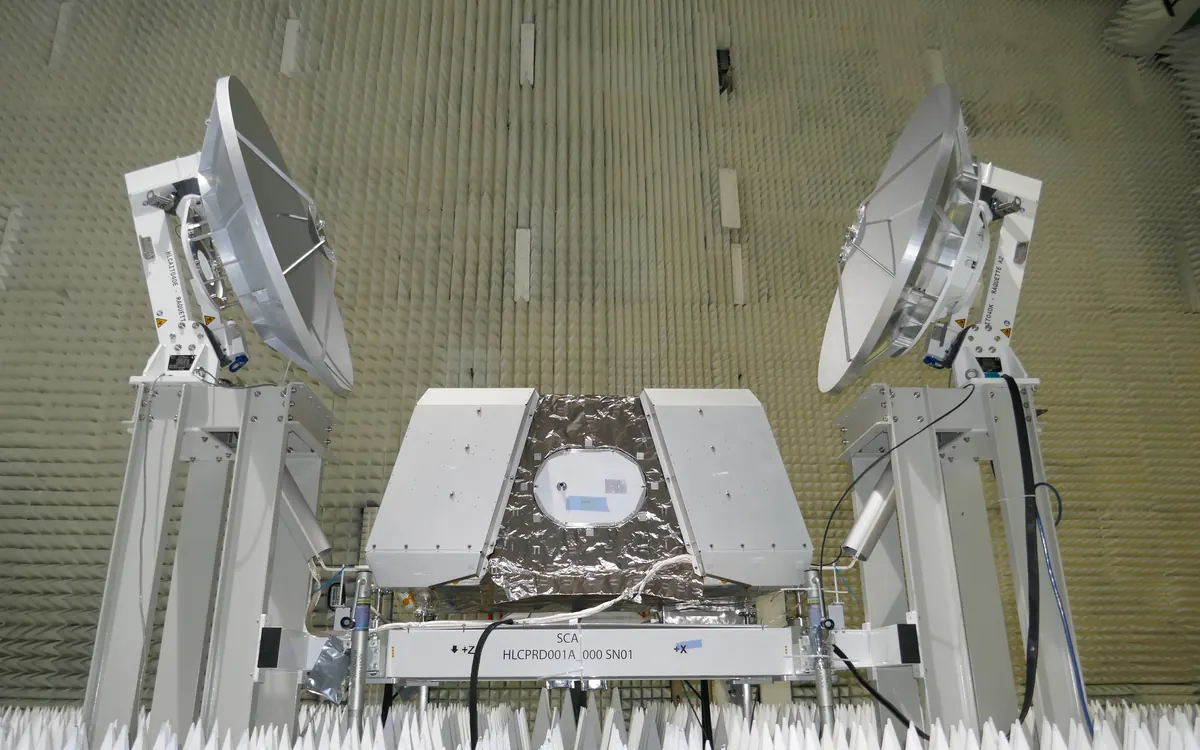
Europe has finished building a piece of Moon hardware that currently has nowhere to go. ESA's Lunar Link is a telecommunications system designed to connect an orbiting station with explorers on the lunar surface. It has completed its last major integration and testing campaign at Thales Alenia Space in Cannes, France, ESA announced on Tuesday.
Lunar Link was meant to fly on NASA's HALO habitation module as part of the Lunar Gateway. NASA decided earlier this year to pause work on the Gateway. At that point, ESA says, Lunar Link was only three months from completion. The test campaign was already running and the test facilities were booked, so ESA and its industrial partners decided to finish the job.
How Lunar Link got here
Mar 2026
Antenna tests, Gateway plans change
The antennas are tested just as NASA's Gateway plans change. Lunar Link is three months from completion.
Summer 2026
Full-system testing
Electronics pass environmental tests and are joined to both high-gain antennas. Balloon-assisted deployment, EMC tests and a NASA end-to-end demo follow.
Jul 2026
A call for new ideas
ESA invites bids for studies on reusing Lunar Link for a future lunar mission.
Sep 2026
Qualification review starts
ESA and Thales Alenia Space begin the qualification and acceptance review.
Oct 2026
Testing complete
The final major integration and test campaign in Cannes wraps up.
End of 2026
Into storage
After the review and a final software update, the flight hardware is stored in flight-ready condition.
The balloon trick
Lunar Link's antennas are designed to unfold in lunar orbit, where they'll be weightless. To recreate that on Earth, engineers lifted the antenna with balloons about four metres across during the deployment test. In the end-to-end demo, NASA brought racks of equipment that pretended to be a user on the Moon. ESA says the system "performs exactly as intended".
What happens next
ESA is now studying how Lunar Link could fly on its own. Mounted on a spacecraft with an extra antenna to talk to Earth, it could become an independent communications relay for future Moon missions by ESA and its partners. The studies will look at spacecraft designs, orbits, schedules, links with ESA's Moonlight lunar navigation and communications programme, and room for extra science payloads.
The system was built by Thales Alenia Space teams in France, Belgium, Spain and Italy, along with MDA in the UK and SENER in Spain.
It's been a busy week for planetary exploration. Japan's MMX probe, which carries ESA communications hardware, launched to Mars's moon Phobos. Earlier this month, the Griffin-1 Moon lander passed its tests at JPL.
More from Science & Space
View all →Read next
UK watchdog moves to open iPhone NFC to Apple Pay rivals
The CMA wants Apple to let UK apps use the iPhone's contactless chip through both main NFC standards, at much lower fees. Consultation closes 17 November.

SwitchBot permanent outdoor lights add Matter for $240
SwitchBot's 30-metre Permanent Outdoor Lights mix RGB effects with real warm and cool white LEDs and join Apple Home, Google Home or Alexa via Matter.

Cyberpunk 2077 Update 2.5 arrives Oct 22: what we know
CD Projekt Red's free Edgerunners 2 Update for Cyberpunk 2077 lands on 22 October with anime-inspired content, cyberware customisation and dual-wielding.