Apple's touchscreen OLED MacBook Pro: price, specs, release
Apple's MacBook Pro with PROLED XDR Display adds touch, a tandem OLED screen and the Dynamic Island. 14-inch from $2,899, 16-inch from $3,399; ships 6 November.
LandGadget Newsroom · · 3 min read
On this page
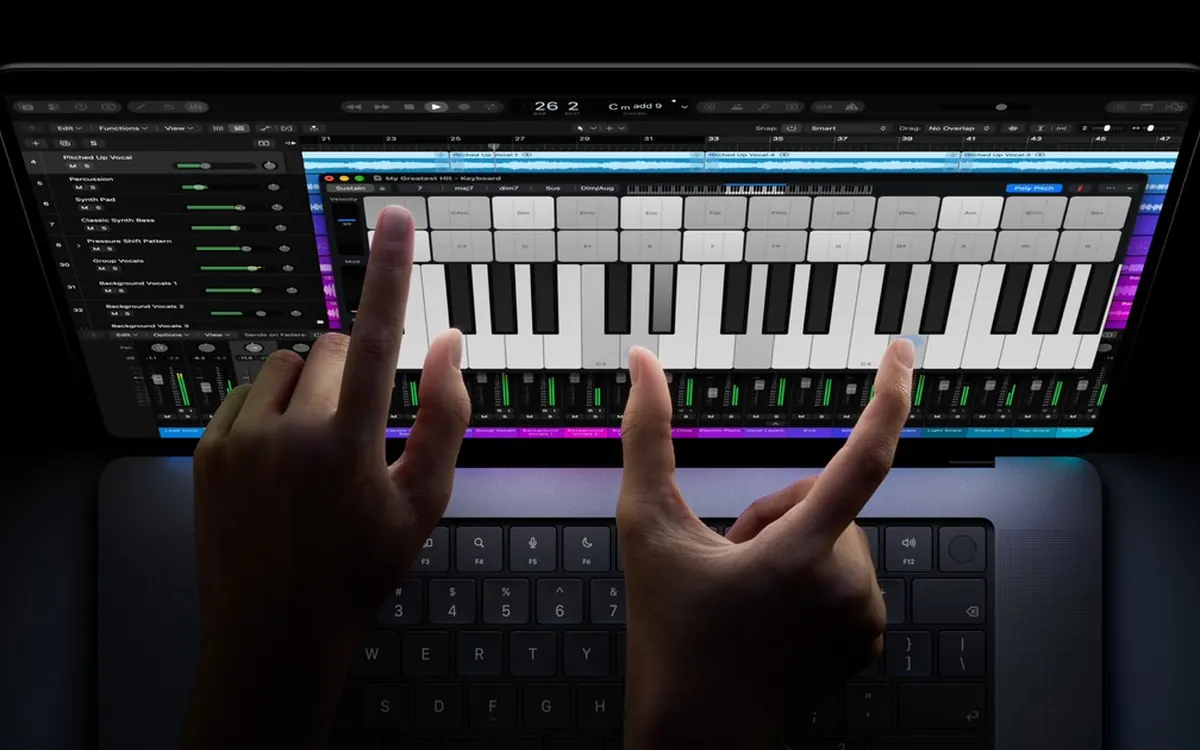
It's official: Apple has announced the MacBook Pro with PROLED XDR Display, the first Mac you can control by touching the screen. The rumours we covered last week, that a touchscreen OLED MacBook Pro could ship on 6 November, turned out to be right on both counts. Pre-orders opened on 28 October in 30 countries and regions, and the laptops start arriving on Friday, 6 November, according to Apple's press release.
The display: tandem OLED replaces Mini-LED
"PROLED XDR" is Apple's name for a tandem OLED panel, the same kind of two-layer OLED it uses in the iPad Pro. Apple quotes:
- up to 2,000 nits peak brightness for both HDR and SDR content (the Mini-LED MacBook Pro peaks at 1,600 nits for HDR);
- a 10,000,000:1 contrast ratio and a 120 Hz variable refresh rate;
- a colour gamut covering both P3 and Adobe RGB, plus reference modes and an optional nano-texture finish.
If you're wondering what changes in practice, our OLED vs Mini-LED laptop guide explains the trade-offs: deeper blacks and no blooming on one side, burn-in risk and sustained brightness on the other.
Touch comes to the Mac
The touch sensor is built into the display panel rather than layered on top, which Apple says reduces latency. You can swipe to scroll, pinch to zoom, drag files and flick windows into tiles, and apps such as Logic Pro, Final Cut Pro and Pixelmator Pro get touch controls. A redesigned hinge is meant to keep the screen steady while you tap it. The notch is gone too: the Dynamic Island now holds Spotlight, Live Activities and Siri.
Same chips, lighter body
Inside are the M5 Pro and M5 Max, the same chips as the Mini-LED MacBook Pro models updated in March, with up to 128 GB of unified memory and up to 16 TB of storage. The difference is the chassis: according to 9to5Mac's comparison, the 14-inch model weighs 3 pounds (down from 3.5) and the 16-inch 4 pounds (down from 4.7). Apple quotes up to 24 hours of battery life, Thunderbolt 5, a 12 MP Center Stage camera and a six-speaker system with deeper bass. It still uses Touch ID; there's no Face ID and no cellular option.
Prices
| Model | M5 Pro | M5 Max |
|---|---|---|
| 14-inch | from $2,899 | from $4,499 |
| 16-inch | from $3,399 | from $4,799 |
The existing Mini-LED MacBook Pro stays on sale at its current prices, and the cheaper M6 MacBook Pro 14 announced on Tuesday starts at $1,999. Deciding how much memory to pay for? See how much RAM you really need.
Frequently asked questions
When is the touchscreen MacBook Pro released?
Pre-orders opened on 28 October 2026 and Apple says deliveries and in-store availability begin on Friday, 6 November.
How much does the MacBook Pro with PROLED XDR Display cost?
In the US, the 14-inch model with M5 Pro starts at $2,899 and the 16-inch at $3,399. M5 Max versions start at $4,499 and $4,799.
Is the new MacBook Pro faster than the Mini-LED model?
Not by chip: both use M5 Pro and M5 Max. The new model adds the OLED touchscreen, Dynamic Island and a thinner, lighter design.
More from Computers & AI
View all →Read next
Robot vacuums for carpets vs hard floors: what to look for
Carpet, rugs or hard floors? Which robot vacuum features matter for each: brushes, carpet boost, threshold height, mop lifting, edge cleaning and setup per room.
ESA's Hera sees Didymos and Dimorphos apart for the first time
ESA's Hera probe has resolved the Didymos–Dimorphos pair from 1,280 km away. First detailed Dimorphos images since DART's 2022 impact are due 25 November.
DLSS vs FSR vs XeSS: which upscaler should you use?
DLSS vs FSR vs XeSS explained: how each upscaler works, which GPUs support it, frame generation and lag, and which setting to pick on Nvidia, AMD or Intel.