Xreal Aura Android XR glasses: price, launch offer and specs
Xreal Aura, the first wired Android XR glasses, is on order in the US, Canada and Korea from $1,279, with a $1,099 launch price to December. Ships mid-November.
LandGadget Newsroom · · 3 min read
On this page
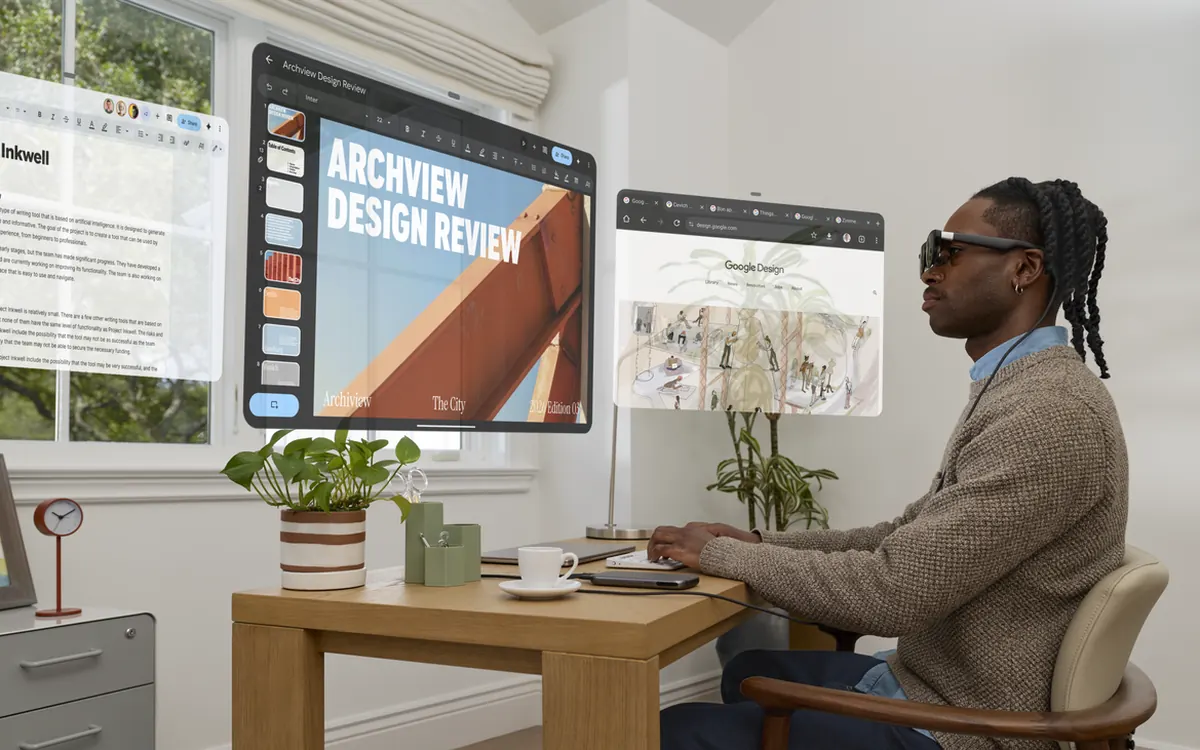
Google's Android XR platform finally has a pair of glasses you can order. At the Android Dev Summit, Google and Xreal launched Xreal Aura, which Google calls the first wired XR glasses powered by Android XR, in a post on its official blog. Orders opened on 28 October in the US, Canada and South Korea, with Japan following on 2 November.
How it works
Aura looks like a pair of chunky sunglasses rather than a VR headset. The lenses are transparent, so you see the real world and your apps float on top of it. The heavy lifting happens in a compute puck about the size of a phone, joined by a USB-C cable. It holds the battery and Qualcomm's new Snapdragon Reality Elite chip, and has a trackpad on the front and a belt clip on the back. That keeps the glasses under 95 grams.
- Field of view: 70 degrees, according to Google.
- Displays: Sony micro-OLED at 1200p and 120 Hz, TechCrunch reports.
- Apps: Google Play apps plus more than 150 apps built for XR, including NBA, Fallout and Project Hail Mary experiences.
- Gemini: the assistant can see what is on your screens and around you and answer questions about it.
- Extras: you can plug a laptop or handheld console into the puck to get a big virtual screen, and Xreal and GameSir made a controller with a dedicated Gemini button.
Price and availability
| Version | Regular price | Launch price (to end of Dec 2026) |
|---|---|---|
| 12 GB RAM, 256 GB | $1,279 | $1,099 |
| 16 GB RAM, 512 GB | $1,499 | $1,299 |
Both come in standard and large sizes with a carrying case and a user-replaceable USB-C cable, according to 9to5Google, which adds that a wider rollout is planned for 2027. TechCrunch says shipping starts by mid-November. Aura is sold at xreal.com and Best Buy.
What it means
Aura is pricier and heavier than Meta's Ray-Ban Display glasses, but it is a full spatial computer with 6DoF tracking rather than a notification screen. For Xreal it's a step above display-only glasses like the Xreal 1 Pro+. And it's a showcase for Google's assistant: Gemini is getting more capable fast, as the newly announced Gemini 4 Carbon shows. Early buyers should keep in mind that Android XR is a brand-new platform, so the app catalogue will matter as much as the hardware.
More from Smartphones
View all →Read next
Robot vacuums for carpets vs hard floors: what to look for
Carpet, rugs or hard floors? Which robot vacuum features matter for each: brushes, carpet boost, threshold height, mop lifting, edge cleaning and setup per room.

ESA's Hera sees Didymos and Dimorphos apart for the first time
ESA's Hera probe has resolved the Didymos–Dimorphos pair from 1,280 km away. First detailed Dimorphos images since DART's 2022 impact are due 25 November.
DLSS vs FSR vs XeSS: which upscaler should you use?
DLSS vs FSR vs XeSS explained: how each upscaler works, which GPUs support it, frame generation and lag, and which setting to pick on Nvidia, AMD or Intel.