Gemini 4 Carbon: Google's top AI model, defenders first
Google's Gemini 4 Carbon tops Artificial Analysis' index and leads security benchmarks, but vetted cyber defenders get it first. Benchmarks, pricing, rollout.
LandGadget Newsroom · · 2 min read
On this page
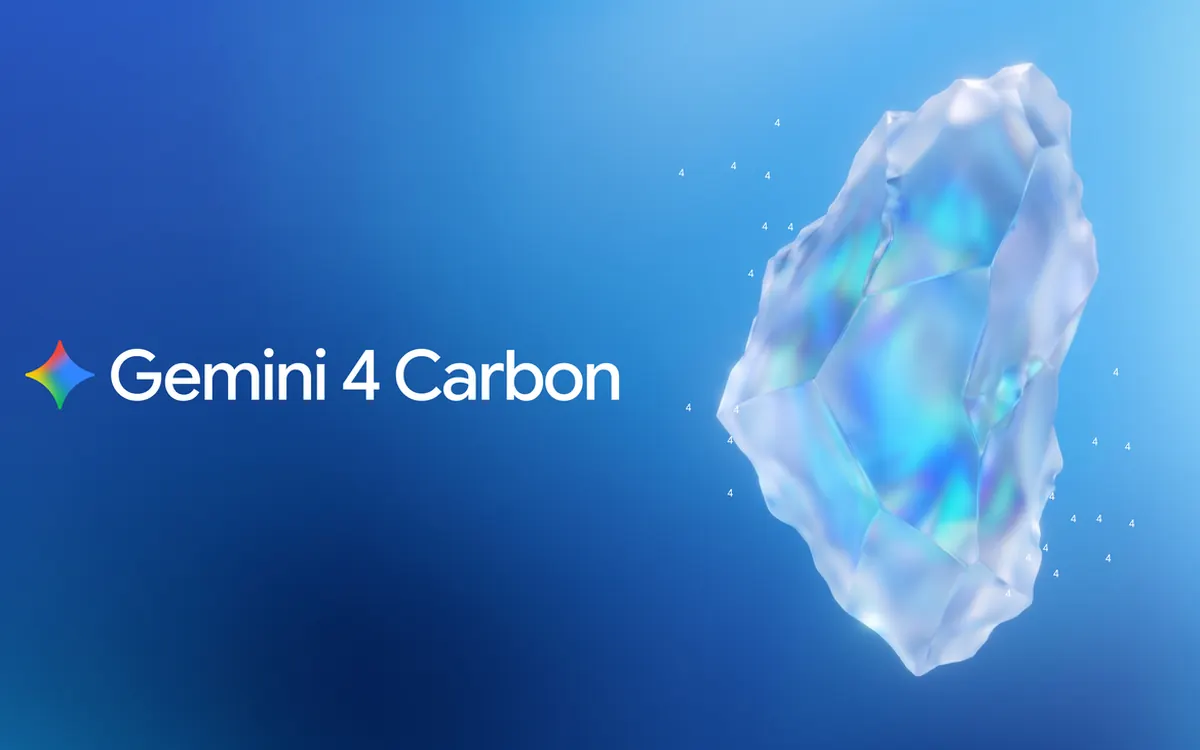
Just two weeks after opening Gemini 4 Argon to everyone, Google has announced its next frontier model, Gemini 4 Carbon. In a post on the Google blog, Google DeepMind's Koray Kavukcuoglu calls it the company's strongest model, with a focus on long-running agentic work and cybersecurity. The catch: most people can't use it yet.
What Google claims
All figures below are Google's own, and the company notes the security benchmarks were run without guardrails:
- #1 on Artificial Analysis' Intelligence Index v5.0, with a score of 59.
- SEC-bench Pro: 88.2% for finding real vulnerabilities in software.
- ExploitGym: 54.8% for checking whether a flaw can actually be exploited.
- CWE-bench: 71.0% for writing fixes for the root cause.
- WebDev Arena: up 89 Elo points to fourth place (1,768).
- More than twice the success rate of Argon at generating secure code on internal tests. The Chrome team says Carbon was over 10 times better than another lab's frontier model at producing high-quality patches.
Google also says Carbon can keep working on hard engineering tasks for days, and that in its own coding environments it showed lower rates of misalignment and fabrication. Ars Technica notes that Carbon only edges out Argon by small margins, and that rival frontier models score in the same neighbourhood on most tests.
Why the slow rollout
Because the model is good at finding and exploiting bugs, Google is taking what it calls a deliberate approach. It is part of the US government's voluntary pre-release testing process, and starting this week Carbon goes to a subset of cyber defenders, then to more trusted partners through its Fairwind Program. Developers, businesses and consumers will get it "as soon as possible", with no date given. Independent pre-release testing is becoming the norm across the industry; see how Anthropic works with outside evaluators like METR.
Pricing
When it reaches the API, Carbon will launch at Argon's introductory price: $2 per million input tokens and $10 per million output tokens, with cached input 95% cheaper. Ars Technica says that price will double once the introductory period ends. If you'd rather run a model on your own hardware, our explainer on open-weight AI models covers the alternatives.
More from Computers & AI
View all →Read next
Robot vacuums for carpets vs hard floors: what to look for
Carpet, rugs or hard floors? Which robot vacuum features matter for each: brushes, carpet boost, threshold height, mop lifting, edge cleaning and setup per room.

ESA's Hera sees Didymos and Dimorphos apart for the first time
ESA's Hera probe has resolved the Didymos–Dimorphos pair from 1,280 km away. First detailed Dimorphos images since DART's 2022 impact are due 25 November.
DLSS vs FSR vs XeSS: which upscaler should you use?
DLSS vs FSR vs XeSS explained: how each upscaler works, which GPUs support it, frame generation and lag, and which setting to pick on Nvidia, AMD or Intel.