Bandwagon-5 lifts off with SpaceX's Starfall and Varda's W-7
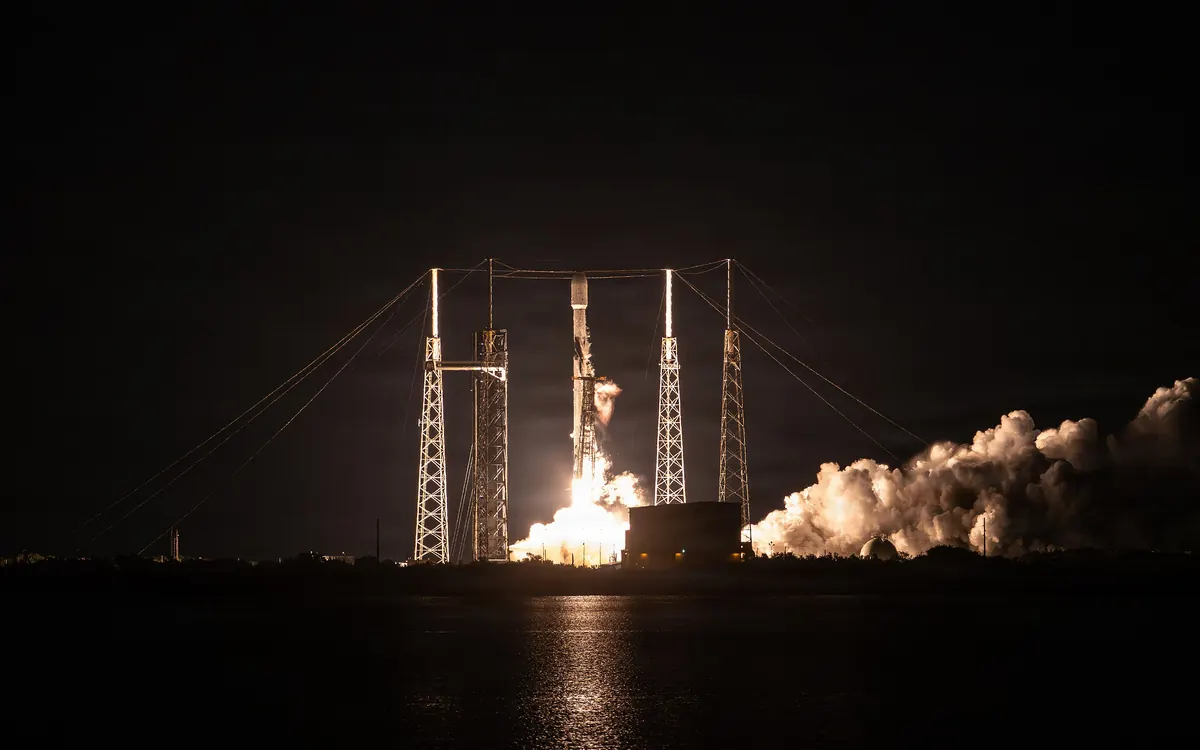
After Monday's weather scrub, Falcon 9 launched Bandwagon-5 with 32 payloads on 20 October, including two reentry capsules, and the booster landed at sea.
LandGadget Newsroom · · 3 min read
On this page
Second time lucky. A day after weather in the recovery zone forced a scrub, as we reported in our preview of the mission, SpaceX launched its Bandwagon-5 rideshare on Tuesday. Falcon 9 left Space Launch Complex 40 at Cape Canaveral at 7:04 a.m. EDT (11:04 UTC, 14:04 Kyiv time), Space.com reports. SpaceX had moved the target from the original 6:30 a.m. slot and rated the weather 95% favourable shortly before launch.
Booster back on the droneship
The first stage, booster B1085, was flying for the 19th time. It landed on the droneship A Shortfall of Gravitas in the Atlantic about nine minutes after liftoff. Spaceflight Now had noted before launch that a successful landing would be the 167th on that ship and the 672nd Falcon booster landing overall.
Starfall's second flight
The headline payload belongs to SpaceX itself. Starfall is the company's uncrewed reentry capsule, which flew its first demonstration mission on 23 June. SpaceX describes it as a way to give researchers and companies "affordable, routine access" to microgravity for experiments and in-space manufacturing, then bring the results home.
The company has shared very little about it. Most public details come from a US Federal Aviation Administration environmental assessment. According to that document, the disc-shaped capsule is about 0.75 m tall and 3.1 m wide, weighs roughly 2,100 kg and can return about 1,000 kg of payload. Starfall sits on top of the payload stack and is the last item due to separate, about 2 hours 48 minutes after liftoff. SpaceX hasn't said what it is carrying or when it will come back.
Varda's W-7 and the rest of the stack
Varda Space Industries flew its W-7 capsule, the company's latest orbital "mini-factory". It carries a cancer-drug compound to test whether crystals grown in microgravity dissolve better. Like Starfall, it is designed to return to Earth, but no landing date was given in the sources we checked.
The other payloads are a mix of cubesats and microsats. They include Planet's high-resolution Pelican-12 Earth-observation satellite, four HawkEye 360 radio-frequency monitoring satellites, six Xona Space Systems navigation satellites and four satellites for Finland's ICEYE, whose radar satellite was recently shadowed by a Russian spacecraft. Deployments were scheduled over almost two hours, starting about 57 minutes after launch.
Bandwagon-5 in brief
Oct 19
Weather scrub
SpaceX calls off the first attempt because of poor conditions in the booster recovery zone.
Oct 20, 11:04 UTC
Liftoff
Falcon 9 launches from SLC-40 at Cape Canaveral with 32 payloads.
T+9 min
Booster landing
B1085 lands on A Shortfall of Gravitas after its 19th flight.
T+57 min
Deployments begin
Satellites start separating over a window of nearly two hours.
T+2 h 48 min
Starfall release
SpaceX's reentry capsule is scheduled to separate last, at about 16:52 Kyiv time.
Bandwagon is the smaller of SpaceX's two rideshare programmes. The other, Transporter, has flown 18 missions. Rideshares and returning capsules made it a busy few days in space: Japan's MMX probe set off for Mars's moon Phobos on Monday. If all this has you looking up at night, our beginner telescope guide and binoculars for stargazing guide are good places to start.
More from Science & Space
View all →Read next
Google Home Speaker bug burns through data; fix rolling out
Some new Google Home Speakers are downloading hundreds of gigabytes in the background, likely due to failed firmware updates. Google says a fix is rolling out.
Cyberpunk 2077 Update 2.5 arrives Oct 22: what we know
CD Projekt Red's free Edgerunners 2 Update for Cyberpunk 2077 lands on 22 October with anime-inspired content, cyberware customisation and dual-wielding.
TorchNeuron explained: AWS opens Trainium chips to PyTorch
Amazon's open-source TorchNeuron lets PyTorch code run on AWS Trainium chips by switching the device to neuron. What it is, what changes and what doesn't.