ALMA's 'cosmic hamburger' shows how giant planets may form
ALMA slices the edge-on disk known as Gomez's Hamburger into layers of gas and dust and spots a clump that may be a giant planet in the making. What it shows.
LandGadget Newsroom · · 3 min read
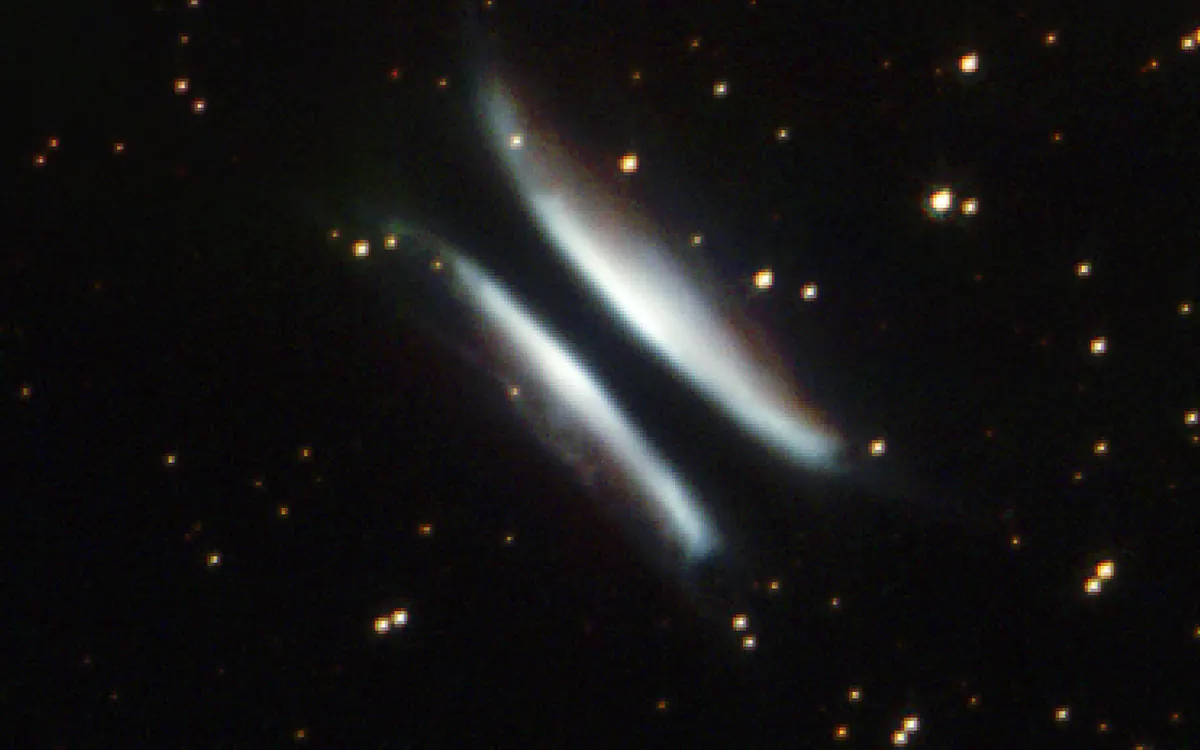
Most planet-forming disks are seen from above, like a vinyl record on a table. Gomez's Hamburger, or GoHam, is seen from the side, so it looks like two glowing buns with a dark "patty" in between. That rare angle let astronomers using the Atacama Large Millimeter/submillimeter Array (ALMA) in Chile measure how the disk is stacked, layer by layer. The results are now published in The Astrophysical Journal, the US National Radio Astronomy Observatory said on 19 October.
What is Gomez's Hamburger?
It's a young star wrapped in a large disk of gas and dust: the kind of place where planets are born. The "buns" are starlight bouncing off dust above and below the disk, and the "patty" is the dense dust lane in the middle, which blocks the light. Its reputation has changed over time: when Hubble photographed it in 2002 (the image above), NASA described it as a Sun-like star near the end of its life. Today NRAO and ALMA describe it as a protoplanetary disk around a young star.
Why the edge-on view matters
From above, you see a disk's rings and gaps but not its thickness. Edge-on, you can see how high each ingredient sits above the disk's midplane. ALMA works at millimetre wavelengths, so it can trace both cold dust and individual molecules.
What ALMA found
- Gas in layers. The most common form of carbon monoxide (¹²CO) sits highest, the rarer ¹³CO a little lower, and carbon monosulfide (CS) closest to the midplane. That matches how models expect disks to be stratified.
- A thin dust "patty". Millimetre-sized dust grains sit in a thin layer in the middle, while gas puffs up far above and below.
- Supersized. Carbon monoxide gas reaches almost 1,000 astronomical units from the star (more than 30 times Neptune's distance from the Sun) and rises several hundred AU above the midplane. The dust mass is many times that of typical disks around similar stars.
Not a perfect burger
The dust is lopsided north to south: one side is brighter and more extended. The team suggests a vortex or another large disturbance that could trap solids, which helps them clump into planets. Faint, wispy carbon monoxide at large distances may be a photoevaporative wind, with starlight slowly blowing gas off the disk.
A giant planet in the making?
The most intriguing find is a one-sided arc of sulfur monoxide (SO) just outside the bright dust. It still follows the disk's rotation, and it lines up with a known dense clump called GoHam b, which is thought to be collapsing under its own gravity. That could be one of the earliest stages of a massive planet forming on a very wide orbit that astronomers have been able to observe.
"GoHam gives us a rare and clear view of the vertical and radial structure of a very large, nearly edge-on disk," said principal investigator Charles Law of the University of Minnesota. He calls it "the perfect laboratory" for studying how giant planets form far from their stars.
Why it matters
Planet formation is usually reconstructed from flattened, face-on views and computer models. GoHam is a benchmark that can test those models directly. It's also a reminder of how much our own galaxy is still being mapped, from Gaia's view of the Milky Way's disc to the new comet Euclid found. Disks like this are far too faint for backyard telescopes, but our beginner telescope guide will get you started on the brighter sights.
More from Science & Space
View all →Read next

OnePlus Ace 7's fan blows two ways to keep your hands cool
OnePlus says the Ace 7 series' built-in fan splits its airflow between the chip and the back panel and keeps hot air off your fingers. Why that detail matters.

Switch Sports Resort lands Oct 22: what's in all 12 sports
The Switch 2 exclusive Switch Sports Resort arrives on 22 October with 12 motion-control sports on Wuhu Island, including Skateboarding and Thumb Wrestling.

UGREEN ID500 Pro is a Matter camera that records locally
UGREEN's 4K pan-tilt ID500 Pro streams and moves over Matter 1.5.1 and records to its new HomeAgent hub. Early-bird prices, what it needs and when it ships.