Does weightlessness change our DNA? A new lab study says no
NYU physicists simulated microgravity on living human cells. The nucleus grew, but the genome's structure held up, and DNA damage came from fluid flows instead.
LandGadget Newsroom · · 2 min read
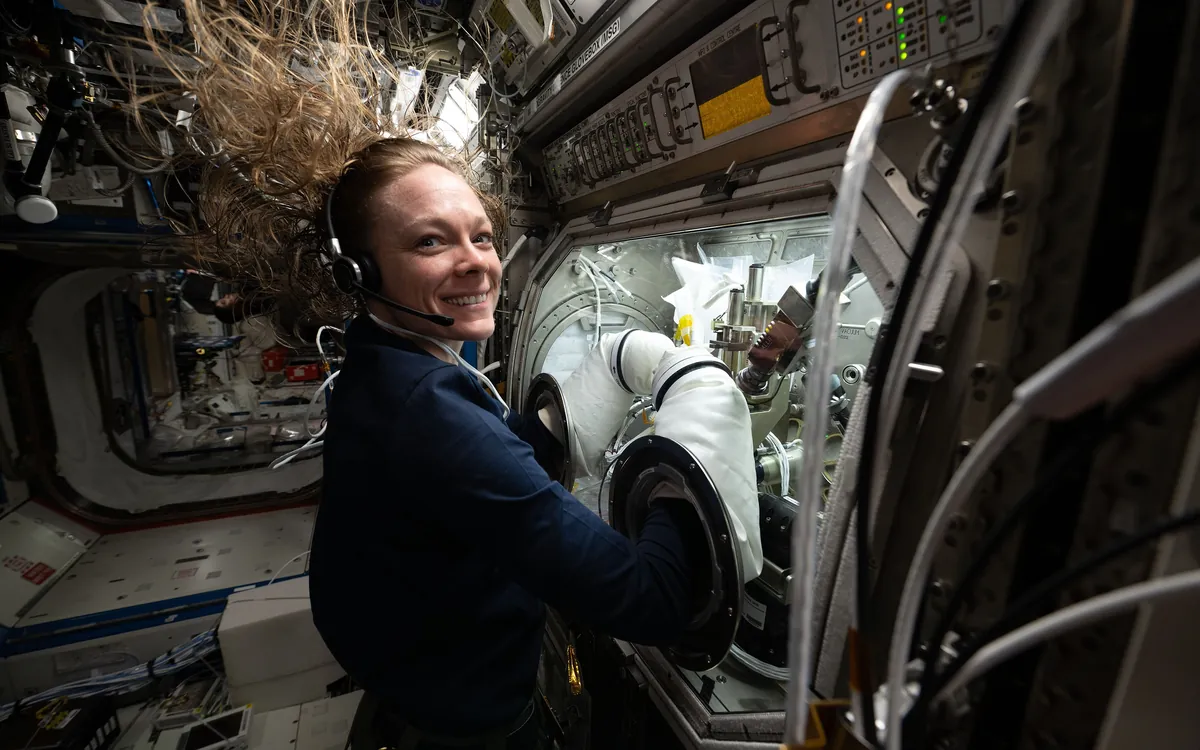
Months on the International Space Station take a toll on the body: muscles waste, bones thin, eyesight and the heart can be affected. NASA's Twins Study even found changes at the genetic level. What scientists still don't fully understand is how gravity shapes the genome inside each cell. A team at New York University has now tackled that question in the lab, as Universe Today reports. Their paper is published in Science Advances.
How do you remove gravity on Earth?
You can't switch gravity off, but you can stop cells from "feeling" a fixed direction. The group led by physicist Alexandra Zidovska at NYU's Center for Soft Matter Research built a random positioning machine, similar in idea to devices used in astronaut training. It turns dishes of living human cells along two axes, so over time the pull of gravity averages out.
The tricky part is that spinning a dish also stirs the liquid around the cells, something that does not happen in orbit. Earlier studies struggled with these flows and with cells clumping together. The NYU team developed 3D algorithms to minimise the flows, and separately tested what the flows themselves do to cells.
What did they find?
After 24 hours, the cells were imaged in detail:
- The nucleus got bigger in simulated microgravity, which suggests that on Earth gravity compresses it slightly.
- Flows stretched the cells, but the thickness and structure of the nuclear envelope stayed the same.
- The genome held its shape. Its physical organisation and the way it moves inside the nucleus were preserved.
- No DNA damage from microgravity. Damage appeared only when cells were exposed to fluid flows.
"Our data show that the genome, its organization, and dynamics are incredibly robust and seem unaffected by gravity, or lack thereof, after 24 hours," Zidovska said.
What does it mean for astronauts?
It is encouraging, but it is not the whole story. The experiment lasted one day, the researchers note that subtle changes could build up over longer stays, and real spaceflight adds radiation that can damage DNA. Understanding those long-term effects matters for missions to the Moon and Mars, and research like this continues on the station, which is supplied by flights such as the Dragon cargo ship that docked this month. For more on the hunt for life beyond Earth, see our story on salt crystals on Enceladus.
More from Science & Space
View all →Read next
OnePlus Ace 7's fan blows two ways to keep your hands cool
OnePlus says the Ace 7 series' built-in fan splits its airflow between the chip and the back panel and keeps hot air off your fingers. Why that detail matters.

Switch Sports Resort lands Oct 22: what's in all 12 sports
The Switch 2 exclusive Switch Sports Resort arrives on 22 October with 12 motion-control sports on Wuhu Island, including Skateboarding and Thumb Wrestling.

UGREEN ID500 Pro is a Matter camera that records locally
UGREEN's 4K pan-tilt ID500 Pro streams and moves over Matter 1.5.1 and records to its new HomeAgent hub. Early-bird prices, what it needs and when it ships.