Simulations show a nuclear blast could shatter an asteroid
Lawrence Livermore researchers modelled a nuclear blast near a 160-metre asteroid. In two of three 3D runs, the rock showed strong signs of breaking apart.
LandGadget Newsroom · · 4 min read
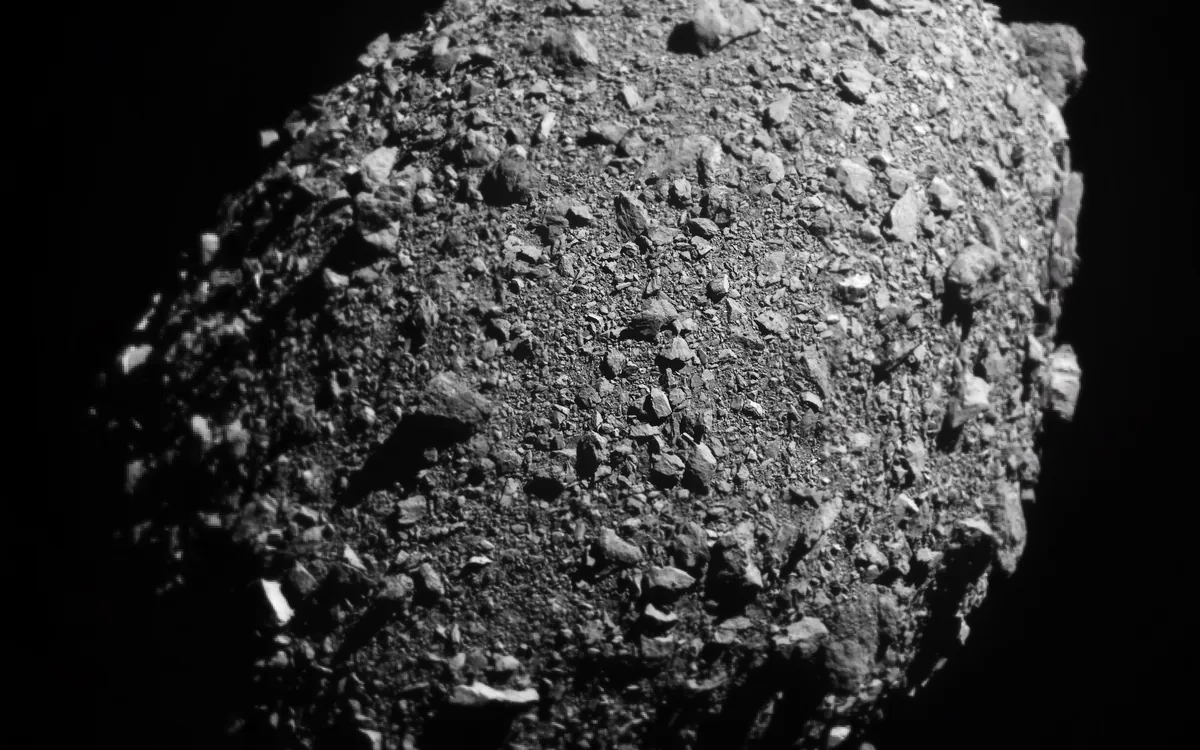
If a large asteroid were found heading for Earth with little warning, a spacecraft simply ramming it might not be enough. That is why planetary defence researchers also study a last-resort option: a nuclear device detonated close to the asteroid. A new study from Lawrence Livermore National Laboratory (LLNL), described in a lab news release this week and published in The Planetary Science Journal, shows in unusual detail what such a blast might do to the rock.
What the team simulated
The idea is not to hit the asteroid with the bomb itself. A device detonated near the surface floods it with X-rays, which heat and vaporise a thin outer layer almost instantly. That can either give the asteroid a small push off course (deflection) or shatter it into pieces that scatter so widely that none of them threatens Earth (disruption).
The team, led by Isaiah Santistevan, added an X-ray energy model to LLNL's Spheral code, which is good at simulating damage, fracture and fragmentation. First they checked it: more than 1,500 one-dimensional runs agreed closely with LLNL's established Ares deflection code. Then they moved to full 3D and modelled three disruption scenarios for an irregular asteroid roughly 160 metres across, changing how far from the surface the device went off and how easily the rock fractured.
The results
Two of the three simulations showed strong signs of disruption. In the longest one, about 98% of the asteroid's material became fully damaged, and about 97% was moving faster than the asteroid's escape velocity, mostly in opposite directions. In other words, the body was flying apart rather than staying together.
One finding was less intuitive. A detonation farther from the surface delivered less energy in total but damaged more of the asteroid, because the energy was spread over a wider area. The researchers stress that this does not make a more distant blast better in general. The best approach depends on the asteroid's size, shape and composition, and on whether the goal is a nudge or a break-up.
Why it is not the final answer
The computing cost is enormous. The longest simulation ran on 1,680 processors for 59 days and still covered only 145 milliseconds of real time. To call a disruption robust, scientists need to show that no remaining fragment is larger than about 10 metres and that the pieces do not pull back together under their own gravity. These runs were too short to prove that. Next, the team wants faster simulations, higher resolution, loosely bound "rubble-pile" asteroids, and comparisons with small laboratory experiments.
NASA's DART mission already showed in 2022 that a spacecraft impact can change an asteroid's orbit. Studies like this one explore what could be done if there were less time or a bigger target. Curious about what is up there yourself? Start with our beginner telescope guide, or catch this week's Orionid meteor shower.
Frequently asked questions
Is any asteroid currently threatening Earth?
No. This is a modelling study of a hypothetical asteroid. It is meant to help researchers evaluate planetary defence options before they are ever needed.
Why use a nuclear device instead of a spacecraft impact like DART?
A nuclear device can deliver far more energy than the kinetic energy of an impactor. LLNL describes it as an alternative emergency option, especially for larger objects or short warning times.
Does the bomb hit the asteroid?
No. In these scenarios it detonates near the surface. Its X-rays heat and vaporise surface material, which either pushes the asteroid or breaks it apart.
Do the simulations prove disruption would work?
Not yet. They cover only 145 milliseconds. Scientists still need to show that no fragment larger than about 10 metres remains and that the pieces do not reassemble.
More from Science & Space
View all →Read next
OnePlus Ace 7's fan blows two ways to keep your hands cool
OnePlus says the Ace 7 series' built-in fan splits its airflow between the chip and the back panel and keeps hot air off your fingers. Why that detail matters.

Switch Sports Resort lands Oct 22: what's in all 12 sports
The Switch 2 exclusive Switch Sports Resort arrives on 22 October with 12 motion-control sports on Wuhu Island, including Skateboarding and Thumb Wrestling.
UGREEN ID500 Pro is a Matter camera that records locally
UGREEN's 4K pan-tilt ID500 Pro streams and moves over Matter 1.5.1 and records to its new HomeAgent hub. Early-bird prices, what it needs and when it ships.