ASUS UGen Arc Pro B70: a 32GB Intel card for running AI locally
ASUS's UGen Intel Arc Pro B70 pairs 32GB of ECC GDDR6 with a 310W design for local LLMs and scales to 128GB of VRAM across four cards.
LandGadget Newsroom · · 3 min read
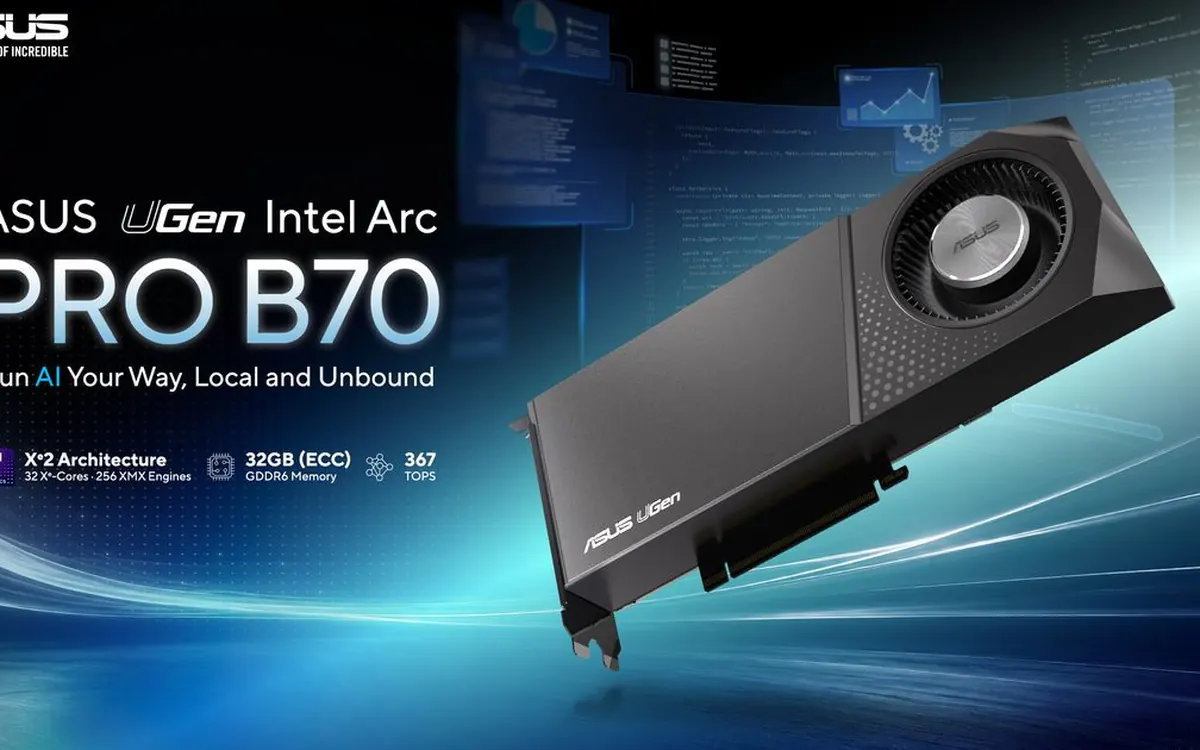
ASUS has announced the UGen Intel Arc Pro B70 32GB, a graphics card aimed squarely at people who want to run AI models on their own machines rather than in the cloud. The pitch is simple: lots of video memory for less money than typical high-VRAM cards. ASUS has not published a price in its announcement.
The key specs
According to ASUS's press release:
- 32GB of GDDR6 memory with ECC (error correction)
- 310W power consumption
- Scales to 64GB with two cards and 128GB with four
- Built on Intel's Arc Pro B70 GPU
Why the memory matters
For local language models, memory is usually the first wall you hit. ASUS points out that long conversations inflate the KV cache, and agent setups that run several models at once multiply memory needs. When VRAM runs out and data spills into system RAM, ASUS says inference speed can drop by up to 90%.
ASUS says a single card handles most models under 27 billion parameters and allows a context window of up to 128K tokens with Llama 3.1 8B. It also claims a dual-card setup runs 80B-class models at 43.4 tokens per second. Those figures come from ASUS, not independent testing. If you want to estimate what your own models need, our new guide on how much VRAM you need for local AI walks through the maths.
Software support
This is the part that has held back non-Nvidia cards for AI. ASUS lists support for Intel LLM Scaler and vLLM XPU, llama.cpp (SYCL and Vulkan), Ollama, OpenVINO and oneAPI, PyTorch XPU and ComfyUI for image generation. Verified models include Llama 3.1/3.2, Qwen 3.x, DeepSeek-R1 Distill, Mistral and Mixtral, OpenAI's gpt-oss 20B and 120B, Whisper-large-v3 and InternVL3.5. ASUS adds that LLM Scaler's built-in INT4/FP8 quantisation removes the need for CUDA-based quantisation tools.
Who it's for
ASUS describes three groups: independent developers who have outgrown 16GB cards, small studios that want 64GB setups while keeping data in-house, and enterprise teams building 128GB systems for regulated fields such as law, medicine and finance. ASUS frames the card as a building block of its "Agent Computer" idea for running AI agents locally.
What to watch
The missing pieces are price, availability and independent benchmarks. The software list is broad, but Nvidia's CUDA still dominates many AI tools, so check that your favourite app supports Intel GPUs before buying. For the wider picture, see our guide to choosing a graphics card and our explainer on open-weight AI models.
More from Computers & AI
View all →Read next

Record gamma-ray burst kept flaring for 27 days
Astronomers say GRB 220706A's central engine stayed active for about 27 days, flaring in X-rays far later than any burst before. What may power it and why it matters.

Samsung reportedly cuts Galaxy A output 20% on memory costs
ETNews says Samsung is cutting Galaxy A production by about 20%, roughly 10 million phones, to favour flagships as memory and chip costs squeeze margins.

Lidar vs cameras for self-driving cars: which is better?
Lidar vs cameras vs radar: how each self-driving sensor works, why Tesla uses cameras only while Waymo, Mercedes and the Rivian R2 add lidar, and what it means.