NASA asks industry how to save Hubble before it falls
NASA wants commercial ideas to reboost, service or safely deorbit the Hubble Space Telescope. The mission would need to fly by 2032; responses are due Nov. 30.
LandGadget Newsroom · · 3 min read
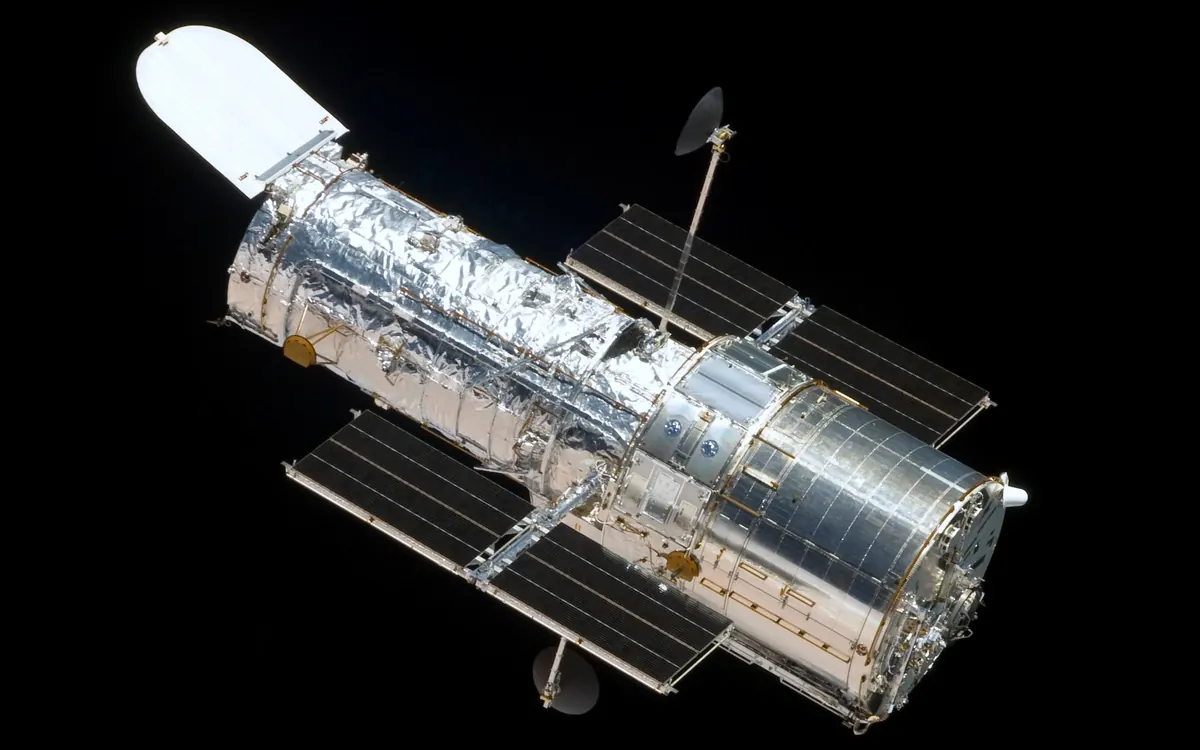
The Hubble Space Telescope is slowly sinking, and NASA is once again asking private companies whether they can do something about it. On Oct. 29 the agency's Goddard Space Flight Center published a Request for Information (RFI) on commercial in-space servicing for Hubble, NASA announced. Ars Technica first highlighted the renewed push.
Three options on the table
NASA wants to hear about current and near-term capabilities for one or more of these missions:
- Reboost: capture Hubble in low Earth orbit and push it to an altitude of at least 600 km (about 373 miles) to extend its science life.
- Servicing: a visit that improves the observatory's performance and makes it more resilient to ageing.
- Controlled reentry: guide Hubble to a safe disposal instead of letting it fall uncontrolled.
Any mission must not harm the telescope and is expected to take place by 2032. NASA would supply technical data, access to its Hubble experts and coordinated telescope operations for rendezvous and capture. The company would have to provide everything else: the launch vehicle, the servicing spacecraft, mission operations and, if the plan involves astronauts, the crew.
Why the deadline is 2032
Like everything in low Earth orbit, Hubble loses altitude to atmospheric drag, and it has no engine of its own. According to the RFI, a lifetime analysis from July 2026 put the chance of reentry at 10% by September 2032 and 50% by December 2033. Forecasts can shift with solar activity, which puffs up the upper atmosphere and increases drag.
NASA makes a strong case for keeping the 36-year-old telescope alive: proposals for observing time outnumber available slots by more than 7 to 1, Hubble's data feed over 1,000 scientific papers a year, and its ultraviolet and visible-light capabilities have no replacement expected before around 2040, when the proposed Habitable Worlds Observatory could be ready.
Not a contract yet
The notice is explicitly not a request for proposals, and NASA has not said how much it would be willing to spend. Responses are due by 3 p.m. EST on Monday, Nov. 30. The idea isn't new: in 2022 NASA studied a SpaceX proposal to reboost Hubble with a Crew Dragon, but decided in 2024 not to pursue it at that time.
Want to see what Hubble sees with your own eyes? Our beginner telescope guide explains what a first scope can show, and the recent Hubble and Webb view of the Cat's Head Nebula shows the telescope is still producing striking science.
More from Science & Space
View all →Read next
What is a normal GPU temperature? Safe ranges and fixes
Normal GPU temperatures at idle and in games, when hot is too hot, hotspot and VRAM readings explained, how to check your GPU temp and 8 ways to cool it down.
Best Monitor Size for Gaming: 24 vs 27 vs 32 Inch
What monitor size is best for gaming? Compare 24, 27, 32-inch and ultrawide screens by resolution, pixel density, desk distance, GPU power and the games you play.

Bluetooth Codecs Explained: SBC vs AAC vs aptX vs LDAC vs LC3
What Bluetooth audio codecs actually change: SBC, AAC, aptX, LDAC and LE Audio's LC3 compared — sound, latency, battery and which phones support which codec.