Hypernovae may never have happened: lopsided ordinary supernovae explain the odd stars
UCL astronomers say four stars long cited as proof of ultra-powerful hypernovae fit better with ordinary supernovae that scatter their elements unevenly.
On this page
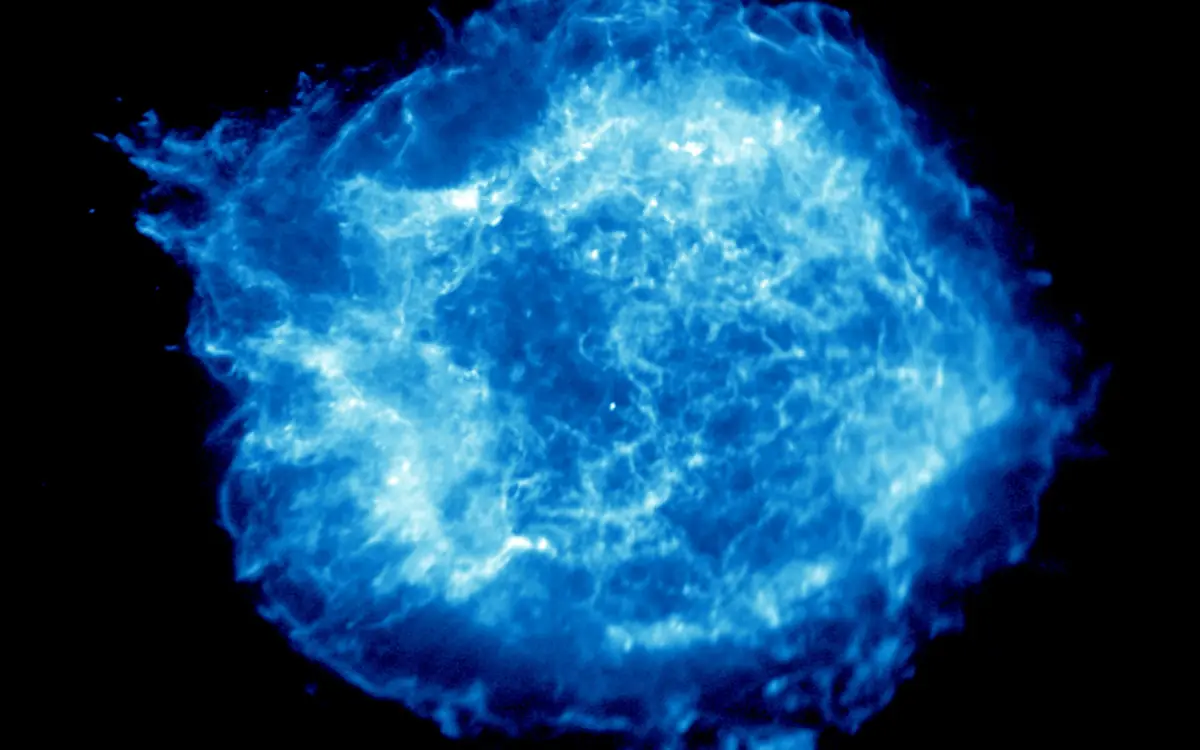
Some of the most powerful explosions astronomers have proposed may not exist at all. In two studies in Monthly Notices of the Royal Astronomical Society, researchers at University College London argue that the main evidence for hypernovae can be explained by ordinary supernovae.
Where the hypernova idea came from
A supernova happens when a massive star runs out of fuel and its core collapses. A hypernova is a theorised, far more energetic version from an even heavier, fast-spinning star. Space.com describes it as roughly ten times more powerful than a typical supernova. The idea was put forward to explain a handful of unusual old stars in the Milky Way's halo and in a nearby dwarf galaxy, whose odd mix of chemical elements seemed impossible to get from a normal explosion.
That reasoning assumed that a new star forms from the full, evenly mixed debris of a single explosion.
Uneven explosions change the picture
The UCL team dropped that assumption. "If we look at a supernova today, the star's materials are not spread evenly," says first author Anmol Aggarwal, a PhD student at UCL's Mullard Space Science Laboratory. "Oxygen might predominantly fly in one direction, sulphur in another." New stars may form from pieces of the explosion rather than from its overall average.
Co-author Ralph Schönrich compares a star just before it explodes to an onion, with heavier elements in the centre and lighter ones further out. Their model works out how much material from each layer would be needed to produce the composition seen in a given star.
- In the first paper, three stars previously linked to hypernovae were better explained by a normal supernova with unevenly spread debris.
- In the second, a fast star that orbits the Milky Way the "wrong" way came out best as the product of an ordinary supernova plus a neutron-star merger. That fit was clearly better than the hypernova one, with an RMS error of 0.24 versus 0.44.
"All the evidence we see for hypernovae is suddenly gone," Aggarwal says. The paper notes that the four main stars cited as hypernova evidence now all have simpler explanations.
Not a final verdict
Other astronomers are cautious. Anna Frebel told Science News that a good fit shows a scenario is possible, but not that it's the only one. The new models challenge hypernovae rather than ruling them out. They also suggest that many other metal-poor stars may need to be reanalysed.
Want to see supernova remnants for yourself? Start with our beginner telescope guide.
More from Science & Space
View all →Read next

GTA VI launch trailer is live — five weeks to November 19
Rockstar dropped the Grand Theft Auto VI Launch Trailer on 15 October, with new PS5-captured footage and a debut score track, ahead of the 19 November release.
How much RAM do you need in 2026? 8, 16, 32 or 64 GB explained
What RAM does, how to tell if you're running out, and how much memory to get for browsing, office work, gaming, video editing and local AI in 2026.

How to choose wireless earbuds in 2026
Fit, ANC, codecs, battery, multipoint and IP rating: a practical buying guide to true wireless earbuds without invented lab scores or brand rankings.