China reveals step-by-step plan for crewed Moon landing before 2030
Chinese officials laid out four test flights of Long March 10, Mengzhou and the Lanyue lander, from an early-2027 orbital test to a crewed landing before 2030.
LandGadget Newsroom · · 2 min read
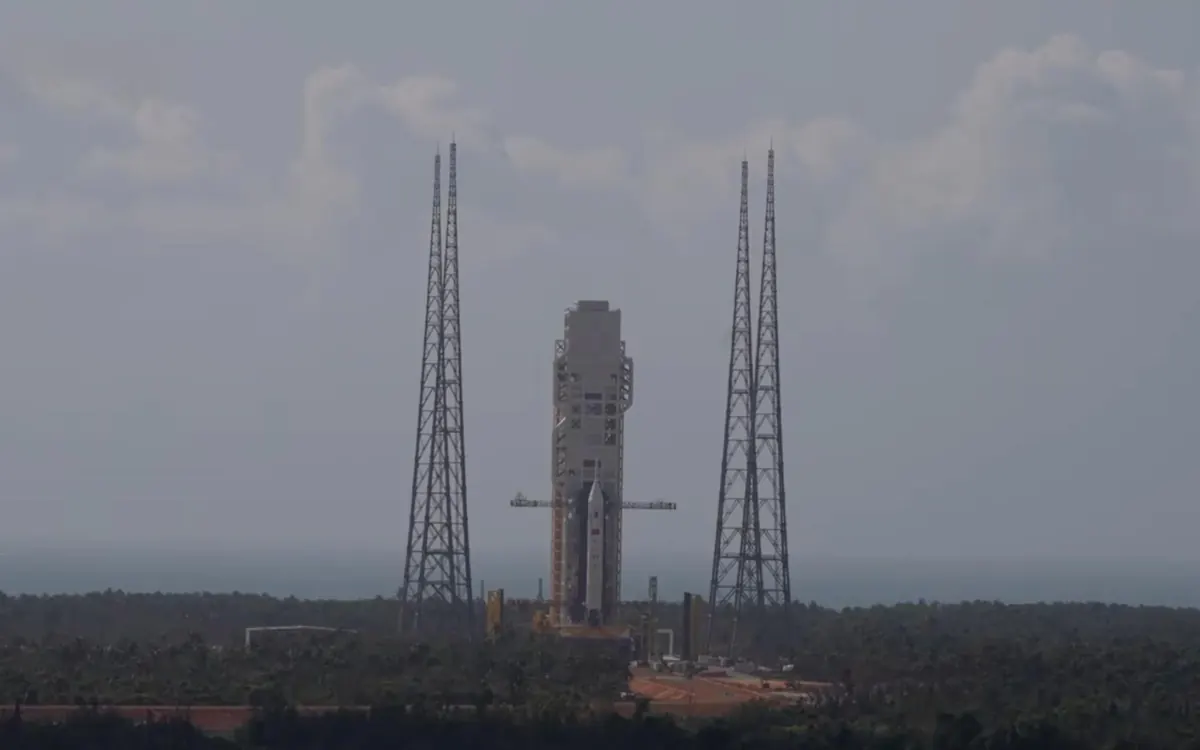
China has given its most detailed public timeline yet for putting astronauts on the Moon. At the Seventh Manned Spaceflight Conference in Beijing over the weekend, officials including Wang Xiang, chief designer of the lunar exploration programme, presented a sequence of missions leading to a crewed landing "before 2030", Ars Technica reports, based on slides shared from the event.
The four steps
- Early 2027: an uncrewed test of the Long March 10A rocket — a single-core version without boosters — carrying the Mengzhou crew spacecraft to low Earth orbit.
- 2028: an uncrewed test of the full Long March 10 (a core stage plus two boosters) with the Lanyue lunar lander, including a descent to the surface and ascent back off it.
- 2029: two Long March 10 rockets launched close together, one with an uncrewed Mengzhou and one with Lanyue; the two vehicles dock in lunar orbit.
- Before 2030: the same dual launch, this time with astronauts aboard Mengzhou, for the landing itself.
How it compares with Apollo and Artemis
China will use lunar-orbit rendezvous, the same basic idea as Apollo. But without a rocket as powerful as the Saturn V, it has to launch the crew and the lander separately and join them near the Moon. Ars notes one notable gap: there is no equivalent of Apollo 8 or NASA's Artemis II — a crewed flight around the Moon before attempting a landing. Mengzhou is expected to fly astronauts to the Tiangong space station in Earth orbit before then.
Hardware is moving. China tested a full-scale mock-up of the roughly 26-tonne Lanyue lander in August 2025, using tethers to simulate lunar gravity, and the Mengzhou spacecraft for the 2027 test has arrived at the Wenchang launch site in Hainan.
The race with NASA
NASA's current target for landing astronauts is 2028 (our report on the Artemis III plans), but that depends on lunar landers from SpaceX and Blue Origin that are still in development, and Ars says a US landing could slip to 2030 or later. Both countries ultimately want a lasting presence at the lunar south pole; NASA's side of that plan is covered in our report on its Moon base rovers. Want to look at the Moon yourself? Our beginner telescope guide explains where to start.
More from Science & Space
View all →Read next

144Hz vs 240Hz: which refresh rate do you need?
60Hz vs 144Hz vs 240Hz explained: what refresh rate really changes, the frame rate your PC needs, which games benefit, and when 360Hz or 500Hz is worth it.
2.4GHz vs 5GHz Wi-Fi: which band should you use?
2.4GHz vs 5GHz Wi-Fi explained: range, speed and interference, why smart home devices need 2.4GHz, when 6GHz helps, and how to fix devices that won't connect.

EV charging connector types explained: Type 2, CCS, NACS
Type 1, Type 2, CCS1, CCS2, CHAdeMO, NACS and GB/T: which EV plug your car uses, which chargers fit, where each is used and when an adapter is safe to use.