ESA Juice’s Earth flyby: record eclipse rehearsal for Jupiter
Juice’s 28 September 2026 Earth gravity assist steered it ~20° toward Jupiter and tested a 3-hour umbra eclipse, keeping batteries above the 35% limit.
On this page
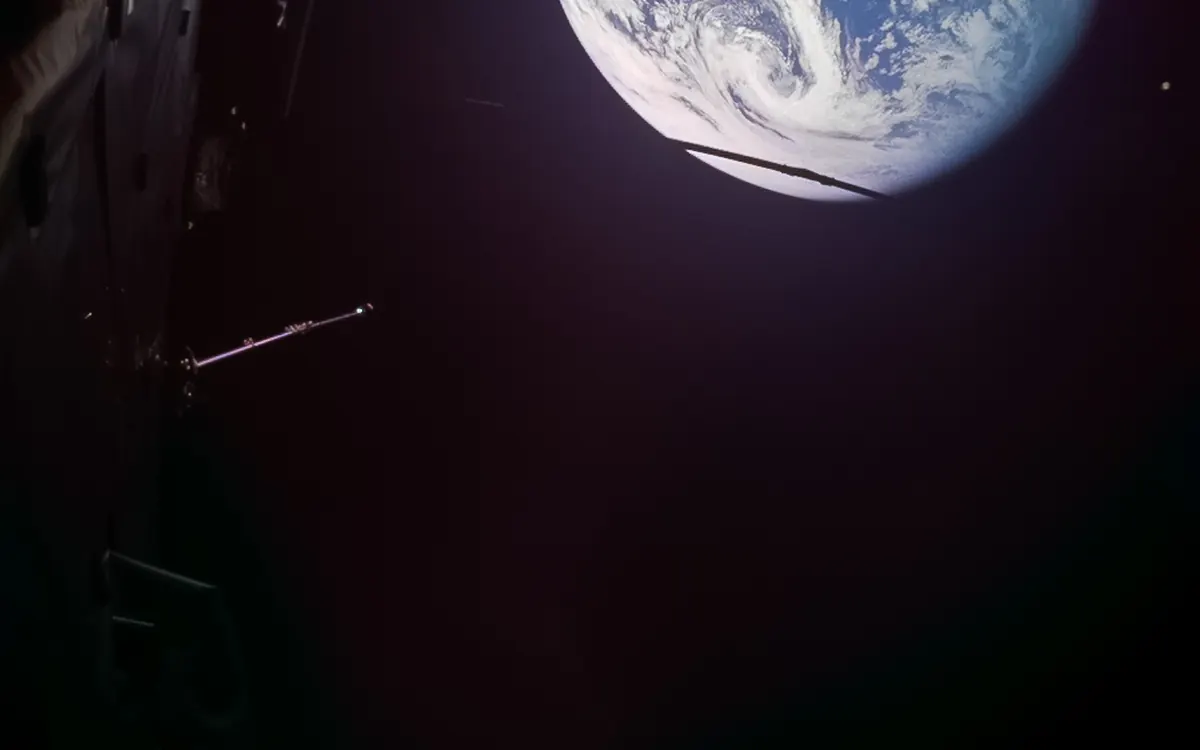
On 28 September 2026, ESA’s Juice (Jupiter Icy Moons Explorer) completed its penultimate gravity assist — an Earth flyby that both bent its path toward Jupiter and doubled as a dress rehearsal for life in the Jovian system, ESA operations explains. Launched on 14 April 2023, Juice is due at Jupiter in 2031. One more Earth encounter is planned for 2029.
Navigation: three of four flybys done
Mission analyst Arnaud Boutonnet notes that a direct trip to Jupiter would need a velocity spacecraft cannot simply “add” after launch — hence gravity assists. After Venus, Juice had enough speed relative to Earth but the wrong heading. This flyby steered the craft about 20 degrees toward Jupiter. That leaves the final Earth pass in 2029 as the last course tweak before cruise ends.
Record eclipse in Earth’s shadow
Before closest approach, Juice spent three hours in full umbra and six hours in partial shadow — a mission record, far beyond the 32-minute eclipse of the 2024 lunar–Earth assist. The profile mirrors Jupiter eclipses that can last up to five hours, where sunlight is only about 3% as strong as at Earth.
Juice flies 85 m² of solar arrays (roughly half a volleyball court). On the evening of 27 September, operators at ESOC watched power fall and batteries rise via the Cebreros Estrack antenna. After the umbra, battery charge bottomed at 54% before arrays recovered at 04:14 CEST — well above the 35% operational floor. Spacecraft Operations Manager Angela Dietz said teams had prepared for more than a year; science engineer Paula Betriu called the power data essential for future Jupiter eclipse simulations.
Science and EAGLE in the dark
At Jupiter, Juice must keep doing science in long darkness. After early worries about payload power, several instruments stayed active through the eclipse; all ten instruments contributed to the wider campaign, though not all at once. Science ops engineer Pilar Esquej described tight prioritisation under eclipse constraints.
The flyby also hosted the first in-flight test of EAGLE (enhanced autonomous guidance through limb extraction). Using NavCam views of the Earth–Moon geometry as a stand-in for Jupiter–Io, EAGLE practised tracking an illuminated limb for precise pointing. Results will be analysed in the coming months. Earth’s shadow even helped: in the hot cruise phase, blocking the Sun let Juice point more freely for observations that heat would otherwise forbid.
More from Science & Space
View all →Read next
GTA VI launch trailer is live — five weeks to November 19
Rockstar dropped the Grand Theft Auto VI Launch Trailer on 15 October, with new PS5-captured footage and a debut score track, ahead of the 19 November release.

How much RAM do you need in 2026? 8, 16, 32 or 64 GB explained
What RAM does, how to tell if you're running out, and how much memory to get for browsing, office work, gaming, video editing and local AI in 2026.
How to choose wireless earbuds in 2026
Fit, ANC, codecs, battery, multipoint and IP rating: a practical buying guide to true wireless earbuds without invented lab scores or brand rankings.