How to choose a dash cam in 2026: what actually matters
Front-only or front and rear, 4K or 1440p, parking mode, supercapacitors, memory cards and the law: a clear guide to picking a dash cam that records when it counts.
LandGadget Newsroom · · 7 min read
Quick verdictPick the number of cameras first, then prioritise night image quality, a supercapacitor and a high-endurance card. Resolution and app features come last.
Jump to the verdict ↓On this page
A dash cam is a small camera that records the road while you drive. If something happens, from a minor bump in a car park to a serious collision, the footage can help show what really happened to your insurer, the police or a court. Most dash cams look similar, and spec sheets are full of big numbers. Here's what actually makes a difference.
Start with how many cameras you need
This is the biggest decision, because it affects price, installation and what you capture.
- Front only: records the road ahead. Simple to fit and enough for many drivers, but it misses the very common rear-end collision.
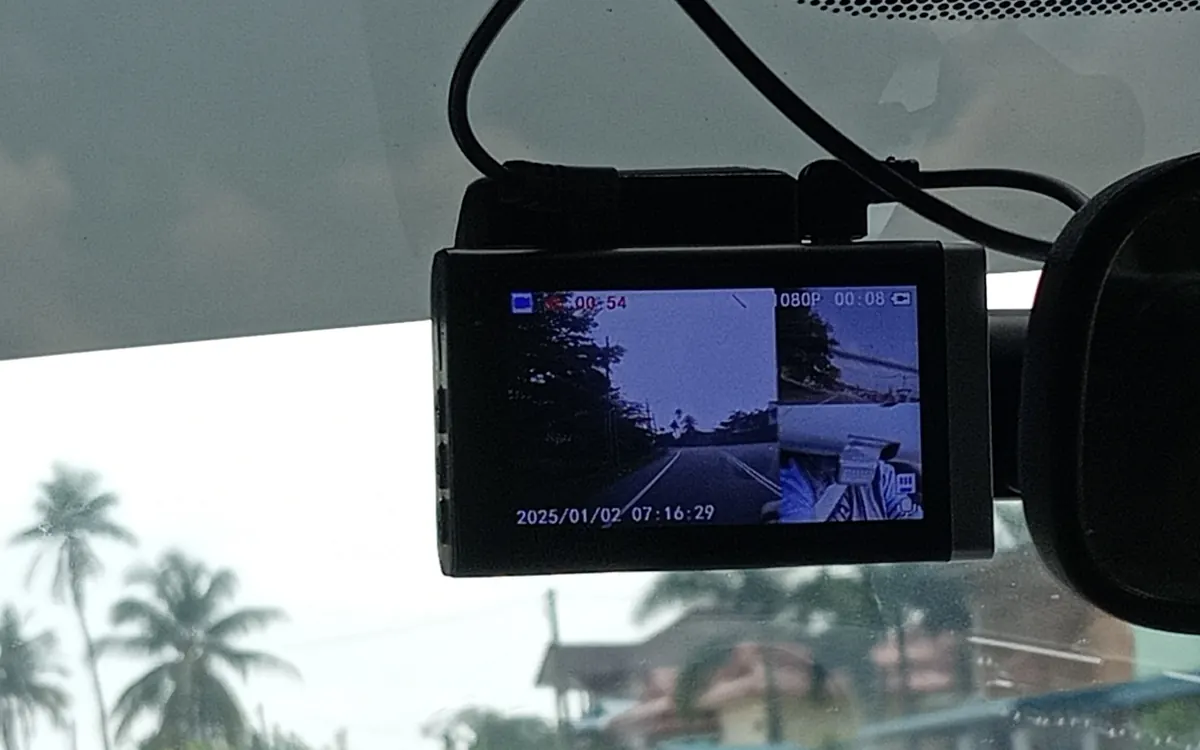
- Front and rear (two-channel): a second, smaller camera on the rear window records what's behind you. For most people this is the sweet spot.
- Three-channel (front, rear and cabin): adds an interior camera, usually with infrared for night. Useful for taxi and ride-hailing drivers or anyone who regularly carries passengers, but it also records the people inside, which brings privacy obligations.
| Front only | Front + rear | Front + rear + cabin | |
|---|---|---|---|
| Covers | Road ahead | Ahead and behind | Ahead, behind and inside |
| Installation | Easiest | Cable to rear window | Most cabling and setup |
| Storage needed | Least | More | Most |
| Best for | Occasional drivers | Most drivers | Taxi, ride-hailing, fleets |
Image quality: night beats resolution
Marketing focuses on resolution, but the footage you need most is often recorded at night, in rain or against low sun. What matters:
- Resolution: 1080p is the minimum. 1440p or 4K on the front camera gives more detail for reading number plates, but only if the sensor and lens are good. A cheap 4K camera with a poor sensor can look worse than a good 1440p one.
- Sensor and HDR/WDR: a good image sensor and high dynamic range processing keep detail in bright skies and dark shadows at the same time, which helps at tunnel exits and at night under headlights.
- Field of view: wider lenses capture more lanes, but very wide angles make distant objects smaller and distort the edges. A moderate wide angle is usually a better balance than the widest number on the box.
- Frame rate: 30 frames per second is standard; 60 fps can reduce motion blur at speed but uses more storage.
The only reliable way to judge image quality is to look at real, unedited sample footage at night, ideally from independent reviews rather than the manufacturer's own clips.
Power, heat and parking mode
Dash cams live in one of the harshest places in a car: behind glass in direct sun in summer and in freezing cold in winter.
- Supercapacitor vs battery: many quality dash cams use a supercapacitor to save the last file when power is cut. Supercapacitors tolerate heat and cold far better than small lithium-ion batteries, which can swell or fail in a hot car. If you live somewhere with hot summers, treat a supercapacitor as a must.
- Power source: most cameras plug into the 12 V socket or a USB port. It works, but leaves a visible cable and switches off with the ignition.
- Parking mode: to record while the car is parked, for example a hit-and-run in a car park, the camera needs constant power. That usually means a hardwire kit connected to the fuse box, or an OBD power cable, ideally with a low-voltage cut-off so it can't drain the starter battery. Parking modes vary: some record only after an impact, others on motion or as a low-frame-rate time-lapse.
+ Pros
- Hardwiring hides the cable and enables parking mode
- Low-voltage cut-off protects the battery
− Cons
- Needs fuse box access or professional fitting
- Constant standby can still drain a weak battery over long periods
In an EV, parking mode draws on the 12 V system, so check your car's advice on accessories; our EV battery care guide covers the main battery habits worth keeping.
Storage: the part that fails first
Dash cams record in a loop, overwriting the oldest footage when the card fills. A G-sensor detects an impact and locks the current clip so it isn't overwritten.
- Use a high-endurance microSD card designed for continuous recording. Ordinary cards wear out much faster under constant rewriting, and a dead card often fails silently.
- Pick the capacity the camera supports. Front-and-rear 4K recording fills a card far faster than 1080p front-only.
- Format the card every few weeks (in the camera) and check now and then that recordings actually exist.
Features worth paying for, and ones you can skip
- GPS: stamps speed and location on footage, which can support your account of events. You can usually turn the speed stamp off.
- Wi-Fi and app: makes it easy to save clips to your phone without removing the card.
- Cloud and LTE: some cameras upload event clips or send parking alerts over mobile data. Handy for valuable cars, but it often needs a subscription and a SIM.
- Voice control and driver-assist alerts: nice to have, but lane-departure and collision warnings on dash cams are usually far less capable than systems built into modern cars.
Also check what your car already has. Some manufacturers offer built-in recording using the car's own cameras, for example Tesla's Dashcam feature or BMW's Drive Recorder, which may be enough for your needs.
Mounting and the law
Fit the camera behind the rear-view mirror, where it doesn't block your view and the wipers keep the glass clear. Route the cable along the headliner and pillar trim rather than letting it dangle, and avoid airbag areas.
Rules differ from country to country. In many places dash cams are legal, but there can be limits on where you mount them on the windscreen, on recording audio of passengers, and on publishing footage that shows identifiable people or number plates, which may fall under data protection rules such as GDPR in Europe. A few European countries restrict dash cam use more strictly, so check local rules before driving abroad. Never handle the camera or app while driving.
Frequently asked questions
Is a 4K dash cam worth it?
Only if it also has a good sensor and strong night performance. A well-tuned 1440p front camera can capture plates as clearly as a cheap 4K model. Look at real night footage before deciding.
Will a dash cam drain my car battery?
Not when it is plugged into a socket that switches off with the ignition. Parking mode uses constant power, so use a hardwire kit or OBD cable with a low-voltage cut-off, and switch parking mode off if the car will sit unused for weeks.
How big a memory card do I need?
It depends on resolution and the number of cameras. Use the largest high-endurance card your camera officially supports, especially for front-and-rear or 4K recording.
Can I record audio inside the car?
Technically yes, but rules on recording passengers vary by country. Many drivers turn audio off by default and tell passengers when it is on.
Our verdict
Front and rear, good night video, supercapacitor
For most drivers, a two-channel dash cam with strong night and HDR performance, a supercapacitor and a high-endurance memory card is the right choice. Add a hardwire kit if you want parking mode, and only pay for 4K, cloud or a cabin camera if you have a clear reason. Whatever you buy, check now and then that it is still recording: a dash cam only helps if the clip is there when you need it. Powering it from a USB port? Our USB-C charger guide explains how USB power ratings work.
More from Cars & EVs
View all →Read next

OnePlus Ace 7's fan blows two ways to keep your hands cool
OnePlus says the Ace 7 series' built-in fan splits its airflow between the chip and the back panel and keeps hot air off your fingers. Why that detail matters.

Switch Sports Resort lands Oct 22: what's in all 12 sports
The Switch 2 exclusive Switch Sports Resort arrives on 22 October with 12 motion-control sports on Wuhu Island, including Skateboarding and Thumb Wrestling.

ALMA's 'cosmic hamburger' shows how giant planets may form
ALMA slices the edge-on disk known as Gomez's Hamburger into layers of gas and dust and spots a clump that may be a giant planet in the making. What it shows.