Physicists trap a single antimatter particle for months
Northwestern physicists held one positron in a 0.3-kelvin trap for months and control its quantum states, setting up a precise test of matter-antimatter symmetry.
LandGadget Newsroom · · 3 min read
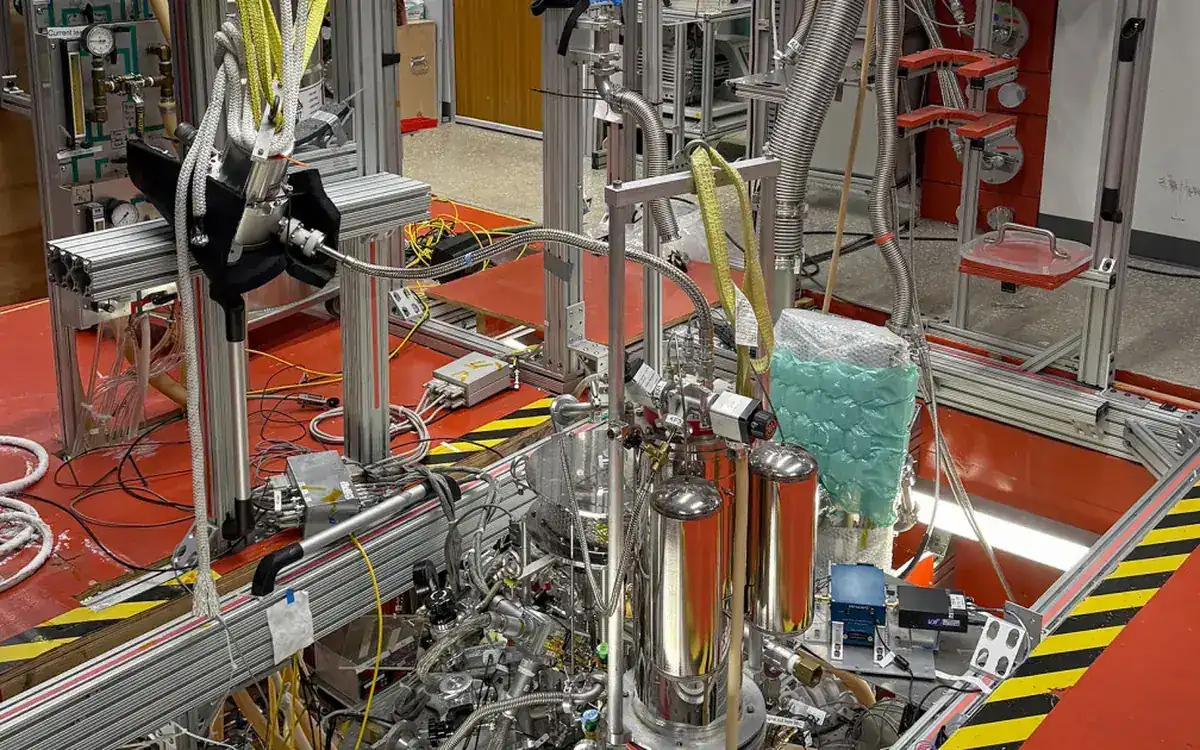
Antimatter is famously hard to keep. Touch ordinary matter and it disappears in a flash of energy. Physicists at Northwestern University have now held one single positron, the antimatter counterpart of the electron, in a trap for months, and can control its quantum state, the university announced. The study, led by Gerald Gabrielse with PhD student Thomas Myers as first author, is published in Physical Review Letters as "One-Positron Quantum Cyclotron".
How you hold antimatter
A positron cannot sit in a normal container, because contact with the walls would annihilate it. The team uses a Penning-style trap in which electric and magnetic fields hold the particle in empty space, inside a near-perfect vacuum. It never touches anything.
The positron comes from the radioactive decay of sodium-22 and starts out moving very fast. The researchers slowed it down, steered it into the trap and cooled the trap's interior to about 300 millikelvin, or 0.3 degrees above absolute zero. At that temperature the particle settles into its quantum ground state.
Gabrielse says that is the key result: "We actually coaxed this very fast positron to sit there and behave for months at a time." He also stresses that the experiment is not dangerous, since there is far too little antimatter for any kind of explosion.
An artificial atom made of antimatter
In this state, the trapped positron behaves like an artificial atom with energy levels the team can see and control. By sending in carefully tuned microwaves, they added tiny, precise amounts of energy and detected the resulting jumps between quantum states. The group calls the set-up a one-positron quantum cyclotron.
The same team previously built a one-electron version and used it to measure the electron's magnetic moment to about one part in 10 trillion, one of the most precise measurements ever made of an elementary particle.
Why it matters
The Standard Model of particle physics says electrons and positrons should be near-perfect mirror images, with the same magnetic properties apart from sign. Comparing the two at extreme precision is one of the strictest tests of that symmetry (known as CPT symmetry). It also connects to a deep puzzle: the Big Bang should have made equal amounts of matter and antimatter, yet the universe is made almost entirely of matter.
The next step is to measure the positron's magnetic moment with the same method and put the two results side by side. Gabrielse expects them to match, but says a difference "would be the biggest discovery in physics in the last century."
It is a reminder that some of physics' biggest open questions are being probed on a tabletop as well as in space, from the hunt for dark matter to lab recreations of odd phenomena such as ball lightning. The work was funded by the US National Science Foundation.
More from Science & Space
View all →Read next
RTX Remix 1.6 adds DLSS 5, Minecraft beta and Windows on Arm
NVIDIA's RTX Remix 1.6 brings DLSS 5 neural rendering, up to 6x Multi Frame Generation, a Minecraft Java beta mod and Arm support for Portal RTX and more.

Steam Personal Calendar leaves Labs: release dates for you
Steam's Personal Calendar is now a full feature: an 8-week list of upcoming releases picked from your playtime, with wishlist, DLC and Early Access filters.

How to check battery health on iPhone and Android
How to check your phone's battery health on iPhone, Samsung Galaxy, Pixel and other Android phones, what the numbers mean, and when a battery replacement is worth it.